Street Safety Is a Storytelling Problem
Cities are telling stories about how to behave. Right now, a committee of engineers is writing them. What happens if we let the fairy-tale painters in instead?

In Zutphen, the Netherlands, there's a painter named Femke Hiemstra whose work might accidentally contain a blueprint for American street design. She has no idea.
I mean this seriously, which is the most dangerous way to mean anything. Hiemstra paints what she calls "Neo-Fabulist" scenes: meticulously rendered jewel-box paintings where teacups grow legs, mice wear waistcoats, and inanimate objects conspire with woodland creatures in a fairytale one-third Beatrix Potter, one-third Hieronymus Bosch, one-third the dream you have after eating a whole wheel of brie. Her work lives between fantasy and reality, rendered with the kind of attention to narrative detail that makes every fox, teacup, and mushroom feel weighted with looming consequence.
Looming consequence. Also a great description of an unprotected left turn on a four-lane arterial.
The Plywood Renaissance
A quiet shift is happening in municipal public works departments. Like most quiet shifts, it involves a lot of orange paint and traffic cones. It's called quick-build, and the elevator pitch is appealingly low-stakes: instead of waiting eight years and forty million dollars to redesign a dangerous intersection, you do it on a Saturday with paint, planters, and what the Valley Transportation Authority politely calls "simple physical objects."
Kittelson & Associates describes quick-build roundabouts as "low-cost, modular" versions of the real thing, installed on timelines measured in months rather than decades. The Association of Bay Area Governments notes these projects "quickly create safe lanes" for people on bikes, on foot, in wheelchairs, and on scooters. CalBike calls them "cost-effective." Transportation For America files them under "tactical urbanism," which sounds like something a 14-year-old would do to his Roblox server but actually describes bolting down rubber curbs to keep an SUV from killing a kindergartner.
The genius of quick-build, per planning firm Alta Planning + Design (cited in the Coalition for Responsible Transportation Priorities' toolkit), is it's "community-led and, based on real-time feedback, iterative and adaptable." Translation: if it doesn't work, you can move it. If it does work, you can make it permanent later. It's the urban planning equivalent of dating before marriage, which, given how many American cities sit trapped in loveless 60-year arranged unions with their stroads, feels like a healthy development.
Quick-build, in its current form, is ugly. Aesthetically, it looks like a Home Depot threw up on a Jackson Pollock. Orange bollards. Yellow stripes. Reflective tape applied with the visual sensibility of a highway flagger who has given up on beauty as a concept. The bones are right. The skin is sad.
This is where Femke comes in.
What If a Crosswalk Could Be a Story?
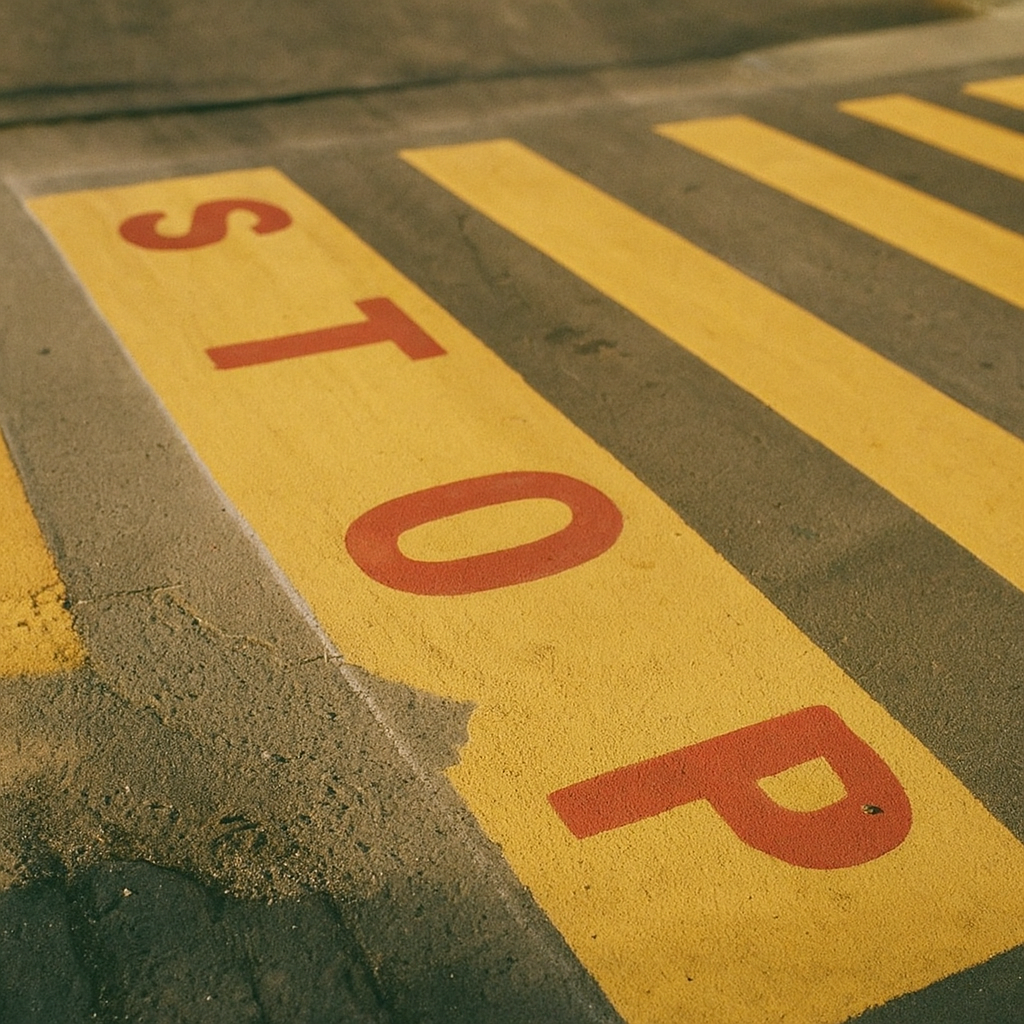
Consider the standard American crosswalk. Two parallel white lines, or if your city is feeling fancy, a series of fat white rectangles known to engineers as "continental" or "ladder" markings. Functional. Legible. Soulless in a way that makes you want to jaywalk out of spite.
Now consider what would happen if Hiemstra, whose work The Stranger called "surrealist fables," were handed a can of thermoplastic and an intersection.
The crosswalk becomes a river. The bollards become mushroom-capped sentinels with stern but kindly faces. The bulb-out at the corner, that little extension of sidewalk that shortens the distance pedestrians cross, becomes a fox's den, painted with the same thin layers of acrylic Hiemstra uses in her studio, sometimes finished with colored pencil. A driver approaching the intersection doesn't see a list of regulations. They see a scene. They see characters. They slow down because something is happening, and humans, by ancient and stubborn design, slow down when something is happening.
This is not whimsy for whimsy's sake. Research on painted street treatments suggests visual interest at intersections can affect driver behavior and attention. The mechanism is simple: unusual elements make you pay attention. A driver scanning a generic four-way will autopilot through it. A driver scanning what appears to be a parliament of waistcoated mice will, at minimum, take their foot off the gas to figure out what hallucinogen they accidentally ingested at lunch.
The Collaboration Nobody Has Pitched Yet
Imagine the meeting. On one side: a traffic engineer named Greg who has spent 22 years optimizing signal timing and can recite the Manual on Uniform Traffic Control Devices from memory like a Catholic doing the rosary. On the other side: an artist who paints mice in waistcoats and means it.
This is a hypothetical. It hasn't happened. It should.
Greg wants throughput. Femke wants narrative. The miracle is they want the same thing, which is for everyone to make it home alive.
Quick-build is the perfect canvas for this marriage because it's meant to be temporary. The whole philosophy, paint and bollards, iterate and adapt, is already artistic in structure. It's a draft. A sketch. The Active Transportation Resource Center frames quick-build as a way to "immediately implement safety needs," but immediacy is also what artists do. Murals don't require environmental impact statements. A painted fox does not need a thirty-month CEQA review.
A city could pilot this for the cost of a mid-sized parks department mural budget. Pair one Neo-Fabulist with one civil engineer. Give them a corridor, maybe one of those grim suburban arterials where someone's grandmother gets hit every other Tuesday, and let them turn it into a storybook. Crosswalks become rivers. Speed humps become sleeping bears. Roundabouts become enchanted clearings where the law of physics requiring you to yield feels less like a mandate and more like a courtesy you extend to the toad in the top hat.
The Looming Consequence
The thing about fairy tales, the real ones, the ones before Disney sanded the edges off, is they're instructional. Don't go in the woods. Don't trust the wolf. Don't speed through the school zone or the gingerbread witch will get you, and also you'll kill an eight-year-old.
Hiemstra's whole catalog operates on this principle: enchantment as warning, beauty as a vehicle for moral seriousness. Which, when you squint at it, is also the job description of a well-designed street. The street tells you a story about how to behave. Right now, in most American cities, a committee of engineers who have never read a novel is telling that story.
Maybe it's time we let the painters in. The traffic cones will still be there. They'll just be wearing waistcoats.
References
- https://www.kittelson.com/ideas/making-streets-safer-faster-the-case-for-quick-build-roundabouts
- https://www.calbike.org/quick-build-designs-improve-street-safety
- https://abag.ca.gov/technical-assistance/quick-build-complete-library-resources
- https://www.vta.org/cdt/street-design-implementation-home-page/quick-build-projects
- https://transportationpriorities.org/quickbuild/process
- https://en.wikipedia.org/wiki/Femke_Hiemstra
- https://caatpresources.org/resource-library/infrastructure/quick-build-projects
- https://www.betweenmirrors.com/2012/11/femtasia-art-of-femke-hiemstra.html
- https://t4america.org/resource/community-connectors/how-things-happen/quick-builds
- https://transportationpriorities.org/quickbuild/designs
- https://www.outregallery.com/blogs/news/femke-hiemstra-talks-otherworldly-folklore-low-brow-paintings
- https://boingboing.net/2009/12/14/femke-hiemstra-art-a.html
- https://www.jaski.nl/artists/femke-hiemstra
- https://designcrushblog.com/2017/10/27/femke-hiemstra
- https://www.thestranger.com/visual-art/2023/05/01/78972434/femke-hiemstras-neo-fabulism
- https://www.portlandmercury.com/visual-art/2023/05/09/46500245/meet-the-mercurys-cover-artist-of-the-week-femke-hiemstra
- https://www.fastcompany.com/91540493/road-diets-safety-quick-build-strategies?partner=rss&utm_source=rss&utm_medium=feed&utm_campaign=rss+fastcompany&utm_content=rss
- https://hifructose.com/2026/04/15/the-drawings-of-femke-hiemestra-depict-fairy-tales-with-looming-consequences
Models used: gpt-4.1, claude-opus-4-7, claude-haiku-4-5-20251001, gpt-image-2
If this resonated, SouthPole is a slow newsletter about art, technology, and the old internet — written for people who still enjoy thinking in full sentences.