The Sound of a Labrador's Paw on a Button While Grandma Yells at Alexa
A Labrador in Milton Keynes is already pressing a button to turn on his owner's lamp. Meanwhile, the rest of us are downloading apps and factory-resetting our dignity. The dog button is trying to tell us something about design — and it's funnier and more serious than it sounds.
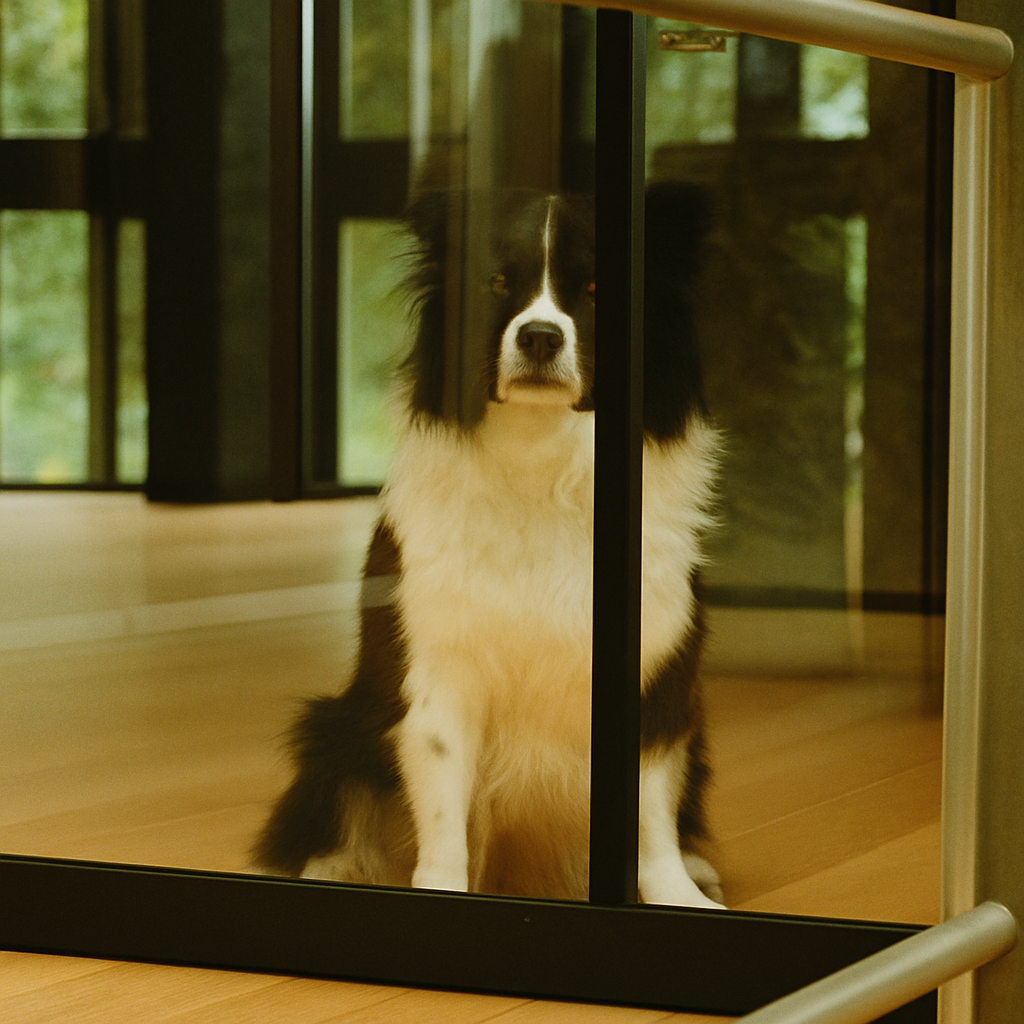
My grandmother spent twenty minutes last Thanksgiving trying to convince her smart speaker she wanted to listen to Andy Williams, not "Andy will yums," whatever those are. Meanwhile, a Labrador named Tito in Milton Keynes was nosing a wireless button to turn on his owner's living room lamp like he'd been doing it since the Carter administration.
I'm not making this up. The Open University's Animal-Computer Interaction Laboratory — yes, a real place where real scientists with real PhDs spend their days asking real dogs what they want — recently launched something called the Dogosophy Button. It's a wireless switch designed for canine paws and noses, built after years of research into what dogs would do with technology if we stopped designing everything for thumbs.
The answer, apparently, is: a lot. They'll turn lights on. They'll start appliances. Service dogs will help disabled handlers without waiting for a human to translate the dog's needs into a format the house understands. Professor Clara Mancini, who runs the lab, has argued for years that interaction design shouldn't stop at our species, and now there's a button to prove it.
I want to sit with this for a moment, because it's funnier than it sounds and also more serious than it looks.
A Border Collie Walks Into a Smart Home
Consider what's happening in the human wing of the smart home industry. Apple has been quietly preparing AirPods with cameras for AI processing, tiny lenses tucked into earbuds so the device can see what you see and supposedly understand your environment better. We already have Adaptive Audio that decides on your behalf when to cancel noise and when to let it in, Personalized Volume that learns your preferences over time, and Conversation Awareness that lowers the music when it detects you've started speaking.
These are sophisticated features. They are also features designed under the assumption that the user — a presumably literate, app-fluent adult with strong opinions about ambient soundscapes — wants the machine to make more decisions for them, not fewer.
The Dogosophy Button operates on the opposite premise. It assumes the user is a beagle. It assumes the user cannot read a settings menu, will never update firmware, has no email address, and couldn't care less about your ecosystem strategy. It is designed for a creature whose entire input vocabulary is "press the thing" and whose entire output expectation is "the thing happens."
Which one sounds more like good design?
What the Dog Knows
Two improv rules apply here. Tina Fey's: always say "yes, and" — accept what your scene partner offers and build on it. Del Close's, which Fey absorbed: treat your audience like poets and geniuses, not idiots. Most smart home design treats us like the third option: distracted shoppers who can be wowed by a new feature name written in sentence case.
A dog can't be wowed. A dog has a use case. The use case is: I want the lamp on, because my person is on the couch and the light helps them read, and I have been trained to associate the lamp being on with everyone being calm, and calm is my entire professional objective. The dog presses the button. The lamp comes on. End of user journey.
Compare this to my last forty-five minutes attempting to get a smart bulb to join a new Wi-Fi network. I held down a button. I held down a different button. I downloaded an app that wanted my location, my birthday, and presumably my mother's maiden name. I factory reset the bulb. I factory reset my dignity. The dog, in this scenario, would have given up and chewed the lamp cord, which would have been faster.
The Inclusion Sleight of Hand
Here's the part that sneaks up on you. When researchers design technology for dogs, they're forced to confront every assumption the industry makes about who counts as a "user." Dogs can't tap tiny icons. Dogs can't read confirmation dialogs. Dogs can't sign EULAs, which makes them luckier than the rest of us.
The Open University team didn't start with a button and ask how to make dogs use it. They started with dogs and asked what kind of object a dog could comfortably and reliably operate with the body it already has. The result is a switch that works for any creature with the motor control to bonk something — which is to say, almost every creature, including my grandmother, including the toddler I babysat last summer, including the uncle who refuses to learn how a touchscreen works on principle.
This is the quiet, almost embarrassing lesson buried in a story about dogs turning on lamps. The people who design for the species we ignore end up making things the rest of us could use. The people designing for the most powerful consumer demographic on earth keep making products that require a help article and a support call and a YouTube tutorial from a guy named Kyle.
Laughing Toward the Light Switch
I don't want to be unfair to Apple. Adaptive Audio is useful, and putting cameras in earbuds is the kind of swing-for-the-fences engineering that occasionally produces something wonderful and occasionally produces Google Glass. Smart home technology is still young, and a lot of its current awkwardness is the awkwardness of any teenager.
But the dog button is trying to tell us something, and what it's saying is: stop. The endpoint of good design isn't a device that requires you to learn its language. The endpoint is a device that learns yours, or, failing that, asks so little that even a creature with no language at all can use it.
If we're lucky, the future of smart homes looks less like an AI watching you through your earbuds and more like a big satisfying button that does one thing well. If we're very lucky, we'll be able to laugh at the years we spent yelling "ANDY WILLIAMS, NOT ANDY WILL YUMS" at a black cylinder, while Tito the Labrador, somewhere in Milton Keynes, calmly pressed his own light on and went back to his nap.
He's not impressed with us. He never was. But he might, if we ask nicely, teach us how to design our way out of this.
References
- https://www.open.ac.uk/blogs/news/science-mct/ou-launches-wireless-button-allowing-dogs-to-control-household-appliances/
- https://www.designboom.com/technology/wireless-button-dogs-control-home-appliances-dogosophy-open-university/
- https://www.mkfm.com/news/local-news/dog-push-button-created-by-milton-keynes-scientists/
- https://www.apple.com/newsroom/2023/06/airpods-redefine-the-personal-audio-experience/
- https://support.apple.com/en-us/104979
- https://www.theverge.com/tech/926376/apple-airpods-cameras-ai-production
Models used: gpt-4.1, claude-opus-4-7, claude-haiku-4-5-20251001, gpt-image-2
If this resonated, SouthPole is a slow newsletter about art, technology, and the old internet — written for people who still enjoy thinking in full sentences.