What We Lose When No One Remembers the Girl with the Blue Eyes
What a Chicago restorer's YouTube channel reveals about how a hurried culture remembers, and the slow hands that pull faces back into the light

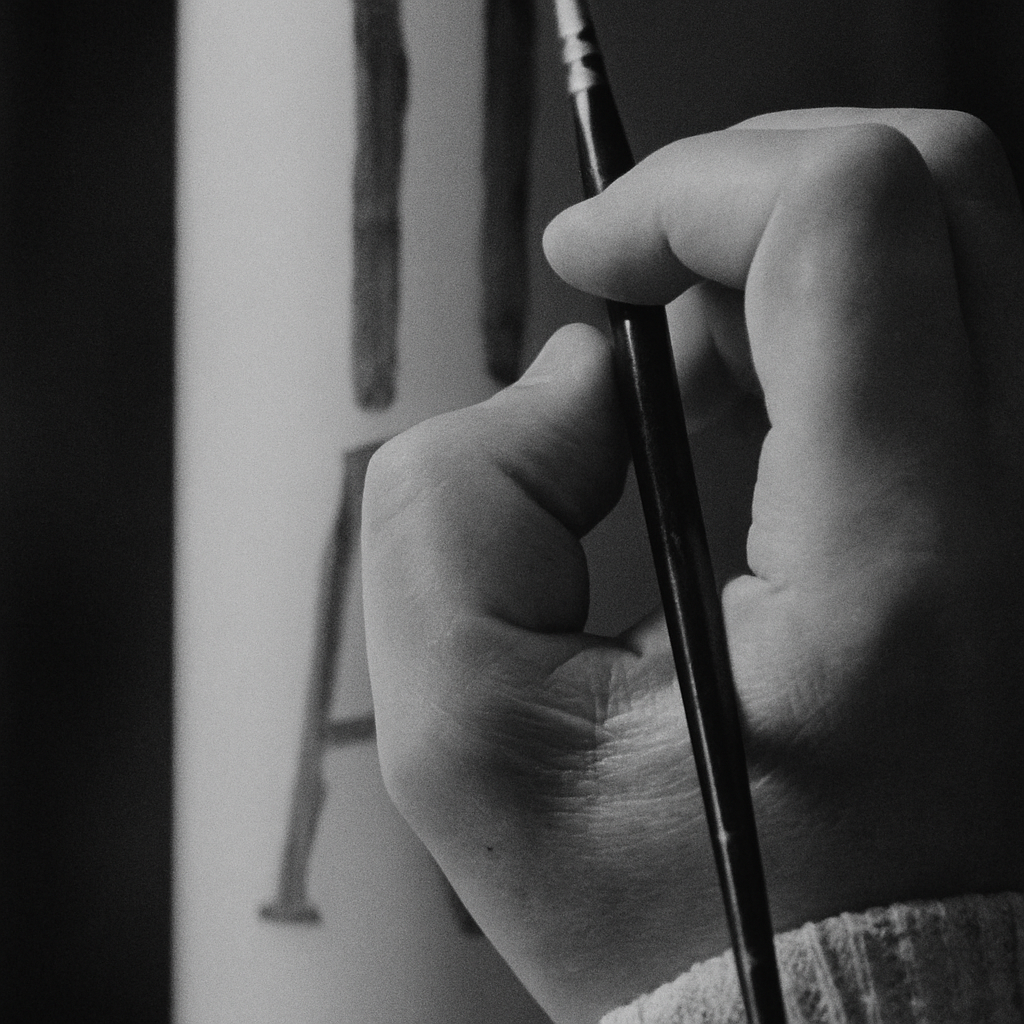
A particular kind of YouTube video has, over the past few years, become a quiet refuge for millions of people who otherwise share nothing in common. The camera hovers above a wooden table. A pair of hands enters the frame holding a swab. A painting, cracked, yellowed, sometimes folded in half like a discarded letter, lies waiting. For the next twenty or thirty minutes, almost nothing happens, and yet everything does. The hands belong to Julian Baumgartner, and what he does, with the patience of someone defusing a bomb made of egg tempera and time, is listen to a stranger speak from across two centuries.
I came to Baumgartner's videos the way most outsiders come to American subcultures: accidentally, then obsessively. A friend sent a link. I watched a portrait of a child, nameless, dated only by the cut of her collar, emerge from beneath a brown haze of varnish someone had applied, perhaps, by some well-meaning dealer in the 1920s. When the haze lifted, her eyes were blue. Someone, somewhere, had once known this girl. Someone had paid a painter to remember her. And then everyone who remembered her had died, and her face had grown dim, and now a man in Chicago was scrubbing her gently back into existence with a cotton bud.
The studio behind these small resurrections is, by the standards of American businesses, almost touchingly old-fashioned. Baumgartner Fine Art Restoration is the oldest conservation studio in Chicago, founded in late 1978 on the North side of the city by R. Agass Baumgartner. Julian took over the studio after his father's death in 2011, and it now sits in the Edison Park neighborhood on the Northwest side, a quiet corner of a loud city. It is a family operation in a country that increasingly prefers its expertise scaled, franchised, and disrupted. Something almost contrarian lives in the fact of a son inheriting his father's swabs and solvents and deciding, in 2011, to simply keep going.
What Julian Baumgartner does on camera is technically restoration, which the field defines, rather charmingly, I think, as the practice of repairing or improving the appearance of a work that has already suffered damage. This differs from conservation, which is about prevention. Restoration is for after. It is, by definition, a discipline of the too-late. And yet the work itself brims with small recoveries. As researchers have noted, restoration often uncovers information hidden under layers of dirt, varnish, or damage: a signature, a date, a second figure standing in a doorway no living person had ever seen. The restorer is part chemist, part archaeologist, part séance medium. A simple cleaning of a modest painting, a 22-by-30-inch canvas, for instance, can cost $350 to $400 and take about a week. The cost of not doing it is harder to calculate, because it is measured in forgetting.
This is the part that interests me most, as someone who tends to watch American culture from a slight distance: the question of what a society chooses to remember, and through what hands. The United States is a country in a hurry. Its relationship with the past is famously ambivalent, sometimes reverent to the point of theater, sometimes blithely demolitionist. And yet here, in a small studio in Edison Park, lives a craft that runs on the opposite metabolism. Hours spent on a square inch. Weeks spent on a face. The labor is invisible by design; if the restorer has done the job well, you will not notice the restoration at all. You will notice only the girl with the blue eyes.
I keep thinking about this in relation to another kind of recovery work, one that operates on people rather than paintings: the prison education programs that, in various forms across the country and the world, try to reconnect incarcerated people with the histories and literatures and selves they have been separated from. The comparison is imperfect. A human being is not a portrait, and to suggest otherwise would be the kind of metaphor that flatters the writer at the subject's expense. But the underlying gesture is similar. Both practices begin with the assumption that something has been buried, by neglect, by varnish, by circumstance, and that beneath the obscuring layers there is a story worth bringing back into the light. Both require a practitioner willing to work slowly, in conditions that do not reward speed. Both produce results the broader culture tends to undervalue precisely because they are quiet.
There is a word I have been searching for to describe what Baumgartner and people like him are doing, and I think the closest I can get is witnessing. The restorer witnesses the painting in its damaged state, witnesses it in the process of becoming itself again, and, through the camera, in Julian's case, invites several million strangers to witness alongside him. This is a strange new form of cultural ritual, and it carries the texture of something older than YouTube: the medieval workshop, the apothecary's bench, the slow accumulation of expertise passed from one pair of hands to another. The platform is digital. The act is older.
What does it mean for our digital memory, that vast, indiscriminate, perpetually buffering archive, that one of its most beloved channels is devoted to the rescue of physical objects? I think it means we have not, despite the prophecies, entirely forgotten the difference between an image and a thing. A scan of a painting is not the painting. A photograph of a face is not the face. There is a stubborn, almost embarrassing residue of materiality in the way we still want our heirlooms repaired rather than reprinted, our grandmothers' wedding rings resized rather than redesigned. Art restoration sits inside this residue. It insists some stories live in matter, and matter requires hands.
The cultural significance of this insistence is, I suspect, larger than the small audience for any individual restoration video. Each cleaned canvas argues, in its small way, against amnesia. Each revealed signature quietly corrects the historical record. Each child whose blue eyes come back into focus reminds us we are, all of us, only ever a few decades of varnish away from being forgotten ourselves, and the people who refuse to let that happen, working slowly in their small studios in Edison Park and elsewhere, are doing a kind of work the culture has not yet learned how to properly thank them for.
So consider this, in its modest way, a thank-you.
References
- https://news.artnet.com/art-world/15-minutes-with-a-price-database-power-user-fine-art-conservator-julian-baumgartner-on-his-most-memorable-projects-1988467
- https://www.ucdavis.edu/arts/blog/restoration-work-can-reveal-what-artist-intended
- https://www.chicagomag.com/chicago-home/july-august-2007/q-we-recently-bought-a-lovely-but-slightly-clouded-looking-old-painting-at-an-auction-how-do-we-get-it-cleaned-or-restored
- https://www.thisiscolossal.com/2026/05/baumgartner-restoration-folded-portrait-painting
- https://aeon.co/videos/the-historian-who-brings-lessons-on-us-prisons-inside-their-walls
Models used: gpt-4.1, claude-opus-4-7, claude-haiku-4-5-20251001, gpt-image-2