Your Next Tattoo Won't Hurt. The Pain Was the Point
CipherX can now deliver a permanent tattoo through an adhesive patch — no needle, no chair, no artist talking you out of the dragon. The pain was never the decoration, though. It was the receipt. And nobody has said what replaces it.
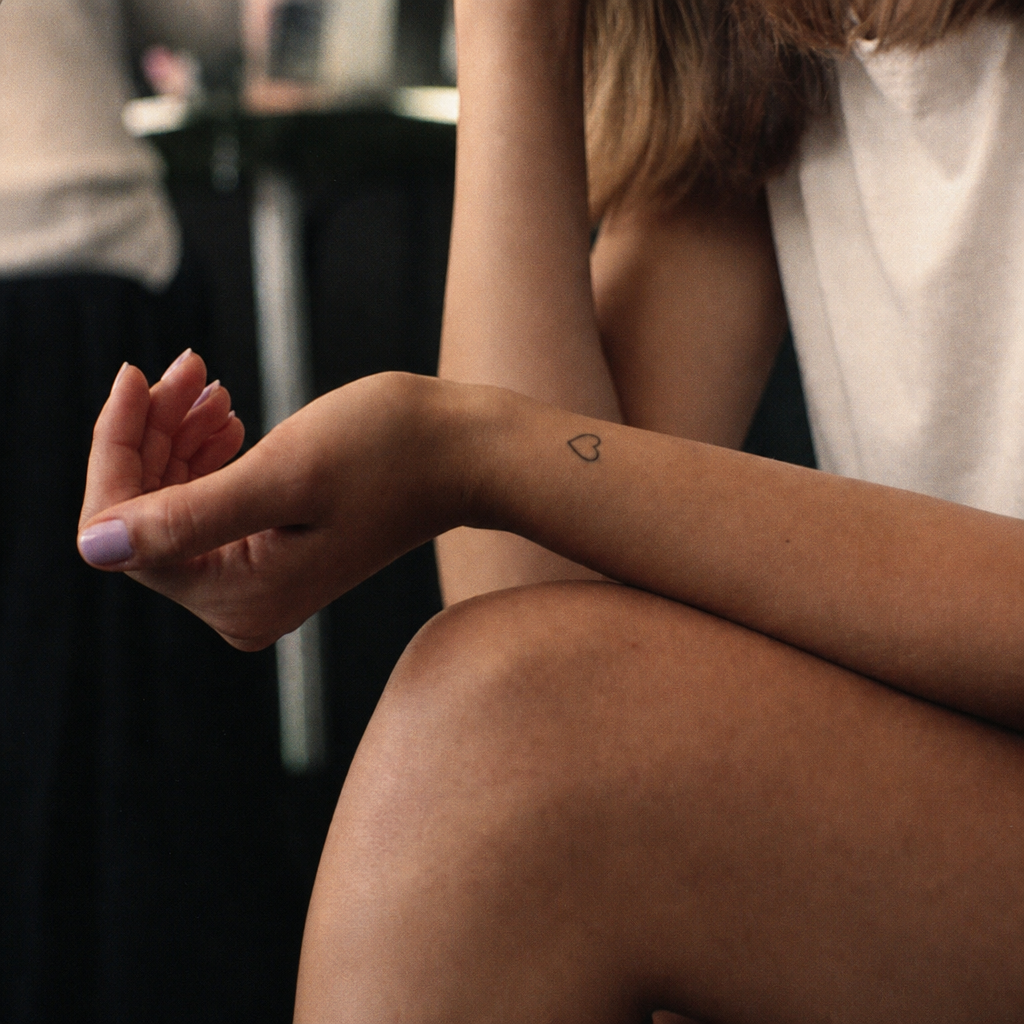
Pain was never the decoration on a tattoo. Pain was the receipt.
CipherX has worked out how to skip it. Ferdinand Kohle co-founded the London biotech startup after training in Innovation Design Engineering, the joint Royal College of Art and Imperial College London program. On July 23rd, at a launch event in Shoreditch (of course it was Shoreditch), CipherX invited visitors to receive a permanent tattoo with no buzzing needle and no bearded man named Dax. A trained technician presses on a small adhesive patch. You wait. They peel it off. Congratulations: you now carry a permanent decision on your body, delivered with all the ceremony of a nicotine patch.
They're called Microdot Tattoos, and per CipherX's own FAQ they use "ultra-fine, microscopic structures (smaller than 1 mm)" to penetrate the upper layers of skin and deposit pigment. I'm sorry, but a millimeter is not microscopic. The product photograph makes that plain: a heart drawn in needles, ranked in rows, visible to the naked eye. And the company never says which dimension — how wide, or how deep. Wouldn't that be the important part? Read as width it's a freckle; read as depth it's a needle with somewhere to be. Regardless, the message lands: too small to matter.
The canvas tops out at a 15 mm circle, smaller than a postage stamp. The company describes the technology as "a hybrid between a traditional tattoo, a medical patch, and a wearable interface" — a phrase both technically accurate and philosophically alarming, like "artisanal cryptocurrency" or "a therapist with a podcast."
Consider the Greatest Generation grandmother who made her own pierogi, refused a dishwasher until 1998, and believed shortcuts were a character flaw disguised as innovation. She would have hated this — hated it the way she hated beards (obviously communist), microwaves, email, and the concept of "brunch." I keep taking her side. That worries me, given her position on beards.
The Ritual and Its Discontents
You sit in the chair. You feel the needle. You bleed a little. You emerge hours later with something yours forever, bought in a currency of endurance. A French tattoo blog covering the launch named the industry's rituals precisely: "the smell of antiseptic, the buzzing of the machine," and the needle prick nobody escapes.
Those rituals earn their keep. When a Māori tā moko artist works on someone, or when a person sits for eight hours to finish a memorial piece for a dead sibling, the pain does something. It's the tuition you pay for the diploma of permanence. Take it away and you're left with — what? A sticker with commitment issues?
I don't want to play pierogi grandmother here. Tattoo pain has also worked as a gatekeeper, excluding people with medical conditions, needle phobias, or a low tolerance for a stranger lecturing them about their font choices. If a diabetic grandmother wants a small heart with her late husband's initials, and a patch spares her a three-hour appointment that terrifies her, who's harmed? The pierogi grandmother, from beyond the grave? She'd get over it. Probably.
The Design Problem Nobody's Discussing
What interests me more than the pain question is the aesthetic one. A tattoo artist collaborates. They squint at your Pinterest board, push back on your bad ideas, redraw the dragon so its anatomy makes sense, suggest the quote from The Office doesn't need to be so large. They serve as the editor between your impulse and your epidermis.
A patch performs no such editorial function. A patch does what the patch does.
Kohle has been direct about this. He says he isn't trying to replace tattoo artists and doubts anyone could. His target is people who would never have sat in the chair at all — including, by his own account, himself at eighteen or nineteen, who wanted a tattoo and was too scared to get one. And CipherX, per their homepage, positions Microdot Tattoos as "safe, fast and convenient" — the three adjectives you want in a smoke detector, less so in a permanent modification of the largest organ you own.
For now, a little friction survives. CipherX staff apply the patches themselves at supervised pop-ups, using a specialized applicator. The FAQ walks through it: a QR code, an ID check, a waiver, five minutes of hands-on work, fifteen minutes with the patch in place, twenty-five to thirty minutes all in. Nobody peels a Microdot onto themselves at home yet. But "yet" is the most load-bearing word in technology. Convenience rarely stops halfway.
A culture swaps its entire personality every eighteen months: a cottagecore phase, a Y2K phase, a quiet-luxury phase, a brat summer, a demure fall. Identities update faster than iPhone software. Into that churn arrives a technology depositing permanent ink in the time it takes to apply a sticker.
The math is unkind.
The Deeper Weirdness
What CipherX sells — and I don't think they'd disagree with the framing — is the decoupling of consequence from commitment. The traditional tattoo economy required you to want it enough to sit through discomfort and hand over several hundred pounds. That friction was a feature. It filtered out the 2 a.m. impulses, the breakup declarations, the ill-advised anime references.
Remove the friction and you get a purer form of desire, unmediated by anything as inconvenient as reflection. Which sounds liberating until you remember most people, handed a frictionless path to any impulse, end up looking like a Spotify Wrapped from their worst year.
And yet. And yet. I keep circling back to the possibility I'm dressing up discomfort with change in the costume of Wise Cultural Commentary. Every generation decides what permanence means to it. For the pierogi grandmother, marriage was permanent. Her granddaughter thinks a haircut is a big decision. Maybe the great-grandchildren will treat tattoos the way we treat earrings — accumulate them, forget them, layer them until the layering becomes the statement.
Coverage at designboom describes the mechanism plainly: the patches leave permanent ink beneath the skin. Permanent. The word carries enormous weight in a sentence about a product engineered to feel as casual as a Band-Aid.
What We're Choosing
The honest admission: CipherX isn't creating a new problem so much as building perfect infrastructure for a problem we already have — the collapsing distance between wanting something and having it. Amazon Prime for the soul. Uber for regret.
Tattoo artists will adapt or they won't. The rituals will survive in some corners and evaporate in others. The Shoreditch launch has come and gone. Somebody will walk out with a permanent dot on a forearm and post about it, because posting is the one ritual nobody skips.
Somewhere, the pierogi grandmother rolls her eyes hard enough to see into next week. And somewhere, a nineteen-year-old designs their eleventh identity of the year, wondering whether this one is patch-worthy.
Both, I suspect, are a little bit right.
References
https://cipherx.tech/blogs/rnd/article-02
https://cipherx.tech/pages/faq
https://materialmatters.design/cipherx-technologies
https://tatufoto.com/es/2026/07/cipherx-tatuajes-sin-dolor-con-parches-solubles
https://tatufoto.com/fr/2026/07/cipherx-des-tatouages-sans-douleur-grace-a-des-patchs-solubles
https://www.dezeen.com/2026/07/24/painless-tattoo-cipherx-launch-worlds-first
https://www.rca.ac.uk/business/innovationrca/start-companies/cipherx-technologies
Models used: gpt-4.1, claude-opus-4-7, claude-haiku-4-5-20251001, gpt-image-2