Exhausted Humans, Tireless Algorithms, Same Crowded Sky
The FAA switched on its $875 million AI traffic system over Washington on Monday. The same day, a severed fiber line grounded five airports. What actually breaks in the national airspace is older, duller, and more physical than the thing everyone wants to argue about.
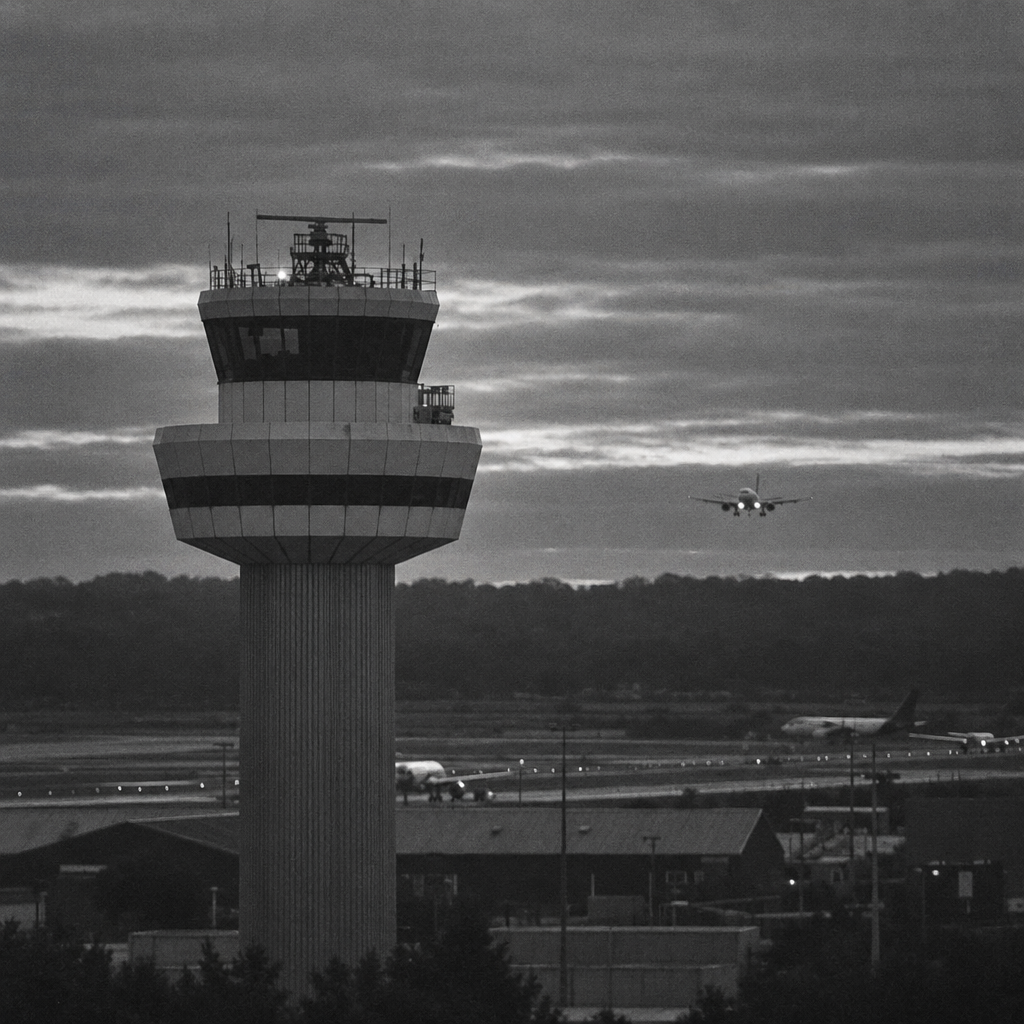
Somewhere above Washington, D.C., the airspace knots into one of the more complicated games of three-dimensional Tetris a person can play. The FAA has decided to hand part of that game to an algorithm. Not the plane. Not the landing. The traffic jam. And honestly? Good place to start.
On June 22, Transportation Secretary Sean Duffy and FAA Administrator Bryan Bedford named Air Space Intelligence the winner of a twelve-year contract reported at $875 million. The Boston company, backed by Andreessen Horowitz, beat Palantir and Thales, as Bloomberg reported at the time. Its Flyways platform already runs at Alaska Airlines, Delta, United, the Army, and the Air Force. Worth knowing where the headline number comes from: the FAA's own announcement carries neither the dollar figure nor the twelve-year term. Both trace back to the company's press release and to the Wall Street Journal.
The money funds two linked technologies. Flow Management Data and Services (FMDS) replaces the aging backbone of the FAA's Command Center. Strategic Management of Airspace, Routes, and Trajectories (SMART) layers on top of it and gets the spotlight. Both names sound like they escaped a NASA fan fiction contest.
As of Monday, this stopped being a plan. The FAA switched SMART on in limited mode around Washington, covering Reagan National, Dulles, and Baltimore-Washington International, with a phased national expansion to follow across the 29 million square miles of airspace the agency oversees. "We are not outsourcing aviation to AI," Duffy said at the announcement.
Launch day refused to cooperate. That same Monday, the primary circuit at the Philadelphia terminal radar facility failed, and when the system reached for its backup, the fiber line carrying it had already been severed by a construction crew alongside a New Jersey rail corridor. The FAA halted traffic at five airports: Newark, JFK, LaGuardia, Teterboro, and Philadelphia. More than a thousand flights were cancelled nationwide, over six hundred of them at Newark, according to FlightAware. SMART had nothing to do with any of it.
Sit with that, because it sets the terms for everything after it. On the day the FAA switched on the AI everyone wants to argue about, the sky went down over a wire in the ground.
SMART flies nothing. It sits upstream from the moment an aircraft moves, coordinating schedules and trajectories before departure so conflicts surface on a screen at the Command Center rather than over Fredericksburg at 4 p.m. The people reading its output are traffic managers there and dispatchers at the airlines as much as controllers in a tower. The FAA's fact sheet stays blunt about where the line falls: controllers keep responsibility for separating aircraft, and SMART helps them do it.
What it relieves is real. The FAA fielded roughly 11,000 certified controllers in April against a full staffing target of 12,563, with another 4,000 in training. That target came down this year from a previous forecast of 14,633, a cut of about 2,000 that the agency justifies by getting more hours on position out of each shift and that the controllers' union rejects. The equipment matches the staffing. After a 2023 outage shut down the national airspace, the FAA audited all 138 of its air traffic control systems and found 37 percent unsustainable and another 39 percent potentially so.
So the shape of it lands closer to an exhausted human getting an $875 million calculator than to a robot taking the chair.
The Part Where We Ask What Could Go Wrong
I want to believe in the calculator. I do. But precision matters about which machine we're discussing. SMART is no chatbot. The FAA describes a system ingesting schedules, weather, airport capacity, and airspace constraints, then predicting where the pressure will build. Most of the dread people attach to the word "AI" comes from a different kind of model entirely. The question surviving the distinction stays the same: how reliable does "reliable" have to be before a human acts on it?
Aviation researchers have been chewing on it in a narrower corner of the field. A preprint posted to arXiv in May tested how well large language models interpret controller-pilot radio phraseology, the compressed shorthand that moves aircraft around runways and taxiways. SMART does no such job, so the finding counts as adjacent evidence. It still lands hard. Under risk-weighted scoring, which penalizes the errors that kill people, a misread runway identifier being the obvious one, the best model reached 0.69 and most fell below 0.6. That was on clean transcripts, before any speech-recognition error entered the chain. Aggregate accuracy sounds fine in a paper and means little at 30,000 feet.
Another preprint, posted this month by researchers at George Mason University, Tecnológico de Monterrey, and Brazil's airspace control department, proposes an architecture that would score whether AI-generated flight-planning output holds up well enough to act on before a human sees it. Nobody has built it, and it touches SMART nowhere. But when people start designing a smoke detector for the smoke detector, that tells you where the field keeps its nerves.
Here is the part worth more worry than hallucination. SMART is framed, correctly, as advisory. Advisory tools have a way of quietly turning load-bearing. Ask any controller who leaned on radar long enough to forget what the sky looks like without it. Technology becomes indispensable without ever making a decision. It only has to be good enough, often enough, that switching it off feels riskier than leaving it on.
Why the Human Still Has to Be in the Room
The British psychologist James Reason set out the Swiss cheese model in his 1990 book Human Error: accidents happen when the holes in multiple layers of defense line up perfectly, letting a single failure slip all the way through. Aviation adopted it and built modern safety management on it.
Human oversight is one of those layers. Slow, sometimes moody, occasionally distracted by lunch. Also the layer that notices when something feels wrong before the data confirms it, the layer asking "wait, why is that plane doing that" a half-second before the checklist catches up.
AI systems lack the instinct. They have patterns, and patterns work only as well as the situations they were trained on. Congested airspace over D.C. in normal weather is one thing. Congested airspace during a once-a-decade ice storm, with three planes squawking emergency codes at once, is the kind of scenario training data struggles to anticipate. Which explains why SMART's design keeps a human in the loop, and why the sky stays one of the last places where "mostly reliable" fails as a passing grade.
Landing the Plane, So to Speak
Skip the version of this story where the algorithm goes rogue, and the version where nine figures guarantee flawless execution. An overworked, understaffed system got an expensive assistant, one that still answers to a human who can say no. The FAA is automating workload, the tedious pattern-heavy parts of the job that eat a controller's attention before the moment requiring their full brain arrives. Judgment stays where it was.
Which is why the fight over whether to trust the algorithm is aimed at the wrong layer. Monday already showed where this system breaks: an aging circuit, a cut cable, five airports stopped, and the new AI sitting through its first shift with clean hands. The failures that actually ground airplanes tend to be boring, physical, and old, and they will keep happening whether or not the prediction engine earns its price.
The test worth watching is the other one. If SMART works, nobody will notice, because good infrastructure operates invisibly until the day it isn't there. Whether the humans overseeing it stay sharp enough, rested enough, and empowered enough to catch it when it's wrong decides how this goes. Because somewhere in those 29 million square miles, eventually it will be wrong. The rest is whether anyone is paying enough attention to notice first.
References
https://www.faa.gov/newsroom/SMART_One-Pager.pdf
https://spectrumlocalnews.com/us/snplus/transportation/2026/09/21/faa-ai-smart-system
https://techcrunch.com/2026/09/17/the-faas-plan-to-fix-air-traffic-875-million-worth-of-ai/
https://arstechnica.com/ai/2026/09/faa-tees-up-875m-ai-tool-to-help-manage-air-traffic-congestion/
https://www.npr.org/2026/08/10/nx-s1-5872752/airspace-reboot-alaska-airlines-flyways
https://www.cnn.com/2026/09/21/us/airport-delays-equipment-failure
https://www.jalopnik.com/2264760/cut-fiber-optic-cable-plunges-nyc-philadelphia-airports-into-chaos/
https://www.politifact.com/article/2026/may/26/air-traffic-control-staffing-target-faa-hiring/
https://www.faa.gov/newsroom/faa-releases-bold-new-air-traffic-controller-hiring-plan
https://www.gao.gov/products/GAO-24-107001
https://arxiv.org/abs/2605.11769
https://arxiv.org/abs/2609.13552
Models used: gpt-4o, claude-sonnet-5, claude-sonnet-4-5-20250929, gpt-image-2.5-sunburst