What Two Satellites Practice Before the Astronauts Arrive
CAPSTONE 02 sends two spacecraft to lunar orbit in 2027 to learn a skill astronauts will need: finding each other across empty space and closing the gap. The station that orbit was built for is shelved. The navigation work outlived it, and infrastructure, given enough time, always becomes culture.
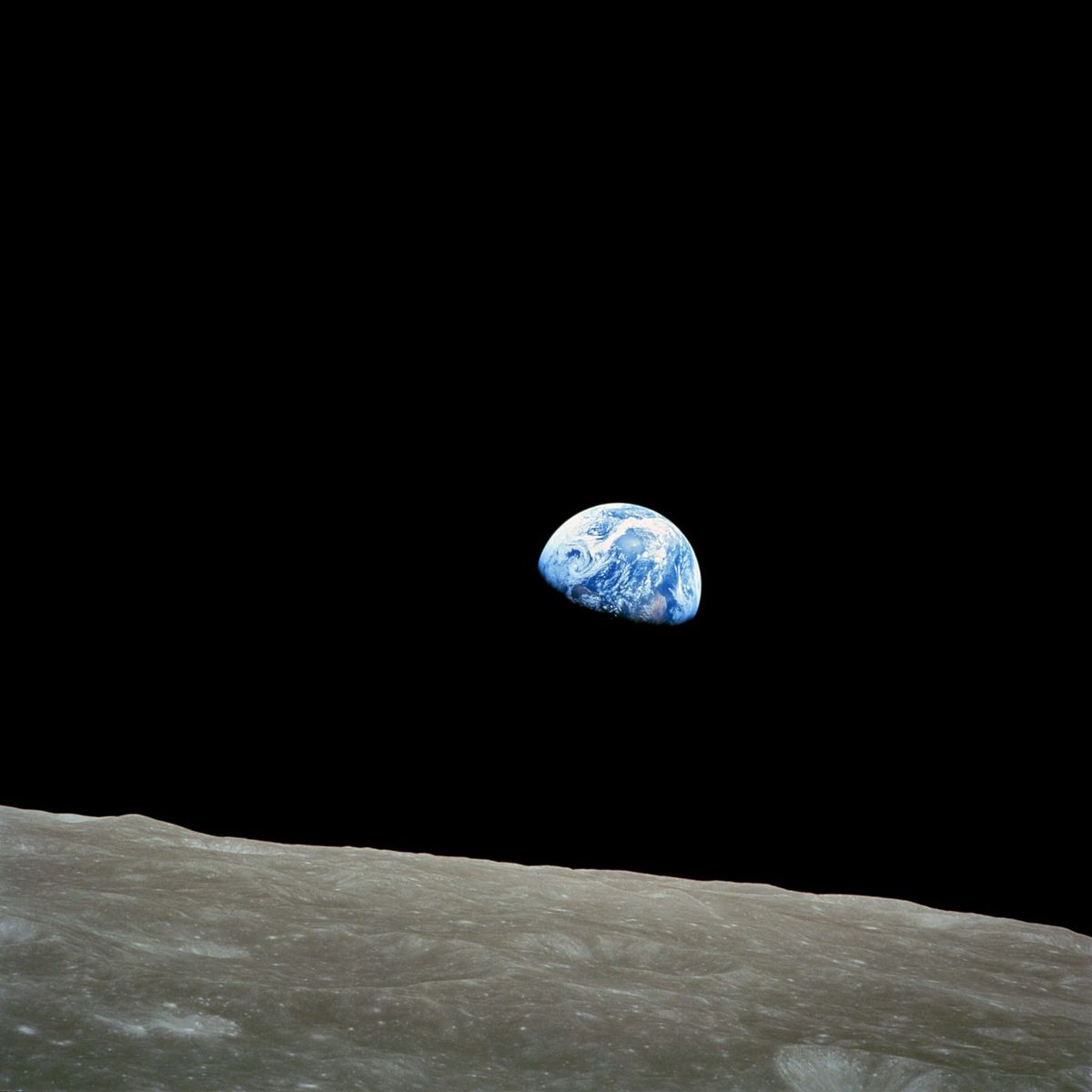
The first photograph of Earth rising over the Moon is black and white. Bill Anders shot it on December 24, 1968, through the side window of Apollo 8, with a Hasselblad and a 250mm lens and whatever film sat in the magazine. Then he called for color, Jim Lovell went hunting for a roll, and the frame everyone knows came a few seconds later. Nothing in the flight plan called for either one. The picture changed environmental politics, poetry, and the way an entire generation pictured the planet it was standing on.
Half a century later we are preparing to hang more objects in that same sky. Two small spacecraft whose job is to talk to each other, find each other, and teach us how to build the invisible scaffolding a lunar economy will stand on. The mission is called CAPSTONE 02. It will never appear on a postcard. It is quietly composing the infrastructure every future lunar postcard will depend on.
The Technical Brief, Read Slowly
CAPSTONE 02 targets a 2027 launch and will fly two spacecraft, 400 kilograms each, in lunar orbit to demonstrate technologies for future lunar and deep space missions. Advanced Space, the Colorado company leading the effort, describes the twin-satellite deployment as an advance in autonomous navigation and rendezvous and proximity operations: RPO, in spaceflight's acronym-heavy dialect.
Read the mission description again slowly, because the substance hides inside the procedural language. Autonomous navigation. Rendezvous. Proximity operations. Two objects, hundreds of thousands of kilometers from any human hand, learning to find one another and exchange data about where they are.
The reason the mission exists sits one layer down. NASA intends these relative navigation techniques to support astronauts docking with landers in cislunar orbit, so crews can transfer to the lunar surface and back safely. The strategies resemble what Orion will need on its approach to a lander. Two satellites practicing on each other now stand in for a crew capsule and a lander later.
The original CAPSTONE flew alone and proved a near-rectilinear halo orbit held steady enough to trust with a future space station. That station has since been shelved: NASA paused Gateway in March 2026 and redirected the money toward a surface base. The orbit, and the navigation work built around it, outlived the destination. CAPSTONE 02 doubles the cast and rewrites the script. The satellites must now work in coordination, maneuvering relative to each other's position, each able to switch between chaser and target.
Signal delay makes real-time joystick control from Houston impractical for delicate maneuvers. Two spacecraft holding position near each other in lunar orbit must reason about their own geometry. They must decide. A spacecraft that decides is, in a small but real way, a spacecraft that behaves.
What the Moon Has Always Been For
Before it became a destination, the Moon was a screen. Every civilization with a night sky has projected onto it: Selene's chariot, the rabbit pounding mochi, the hare the young Maya moon goddess cradles in her lap, the face we still teach children to find. Along with the Sun, the Moon is the one image every human culture has been able to look at. It has served as calendar, deity, planting clock, and, in a belief that has outlived its evidence, a regulator of menstrual cycles. For a few extraordinary years around the turn of the 1970s, it also served as a live television studio. The broadcasts ran through Apollo 17 in December 1972, and the color camera bolted to the rover gave the Moon its longest run on air.
What strikes me about the Apollo era, looking back, is how fast the engineering metabolized into cultural material. Within a few years of Armstrong's boot print we had Pink Floyd's The Dark Side of the Moon and enough science fiction to fill a used bookstore. Two decades later Nick Park sent Wallace and Gromit up there for the cheese. The hardware seeded the imagination. Lunar hardware, real or aspirational, has never stayed hardware for long. It becomes story, image, argument, prayer.
The CAPSTONE 02 satellites will stay invisible to the naked eye. They will plant nothing. They will demonstrate the navigation and communications techniques a sustained lunar presence will require. Infrastructure, in other words. And infrastructure, given enough time, always becomes culture.
Infrastructure as Artifact
Consider how the interstate highway system became Americana: the roadside diner, the road movie, Two-Lane Blacktop burning fuel across a landscape the Federal-Aid Highway Act built. Consider how undersea telegraph cables compressed the Victorian sense of distance, turning news from weeks-old cargo into same-day correspondence. Consider how GPS, a Cold War military navigation system, now underwrites Pokémon Go and the way teenagers meet for coffee. The pattern holds: functional systems, once dense enough to disappear, start leaking cultural meaning from their edges.
Cislunar infrastructure sits at the start of that arc. Peer-to-peer ranging in lunar orbit has already flown; the first CAPSTONE traded ranging signals with NASA's Lunar Reconnaissance Orbiter. The twin CAPSTONE 02 spacecraft are an early rehearsal for what could become a lunar internet: a mesh of small, autonomous objects that fix their positions by referencing one another instead of leaning on constant Earth handholding. If that architecture holds, the Moon becomes an environment we inhabit remotely, mediated by machines exchanging data among themselves.
Designers should pay attention. Every long-lived infrastructure eventually accretes a visual language: the Bauhaus severity in an electrical substation, the typography on highway signage, the sonic branding in a Windows startup chime. What will the visual and interaction language for cislunar operations look like? Who is designing the mission-control dashboards a generation of lunar logistics operators will stare at for entire careers? These questions determine whether the Moon, experienced through screens, feels like a warehouse floor or a place worth loving.
The Interdisciplinary Opening
This part excites me most, and the technology community has historically handled it worst. Space agencies build for engineers; artists arrive later, usually as commissioned decorators. CAPSTONE 02 hints at another possibility. Autonomous RPO is fundamentally a problem two agents share: relative sensing, intention, trust. Choreography works the same way. So does chamber music. So does conversation.
Composers, dancers, game designers, and interaction researchers belong in the room while engineers define these autonomy protocols, shaping how machines should behave around one another when nobody watches. The behavior two spacecraft settle into while holding position in lunar orbit is, at some level, a structured exchange. Someone should think about it that way, and I suspect the mission planners would welcome the company if asked.
Educationally, the mission is a gift. It compresses orbital mechanics, autonomous systems, mesh networking, and industrial design into one tractable case study: small enough for a semester, real enough to matter. A curriculum built around CAPSTONE 02 could teach a sixteen-year-old more about modern engineering than four years of textbook abstraction.
The Reflection
The Moon has always worked as a mirror. We look up and see whatever we most need: a god, a calendar, a Cold War finish line, a romantic backdrop. CAPSTONE 02 reflects something quieter, a picture of method. Two small spacecraft, learning to pay attention to each other, two and a half seconds of round-trip radio from home.
Do this well and the sky above us becomes a working studio. And the algorithms we send there, composed thoughtfully, will still remember how to dream.
References
- https://www.nasa.gov/mission/capstone02/
- https://www.nasa.gov/directorates/armd/nasa-announces-new-spacecraft-technology-demonstration-mission-at-moon/
- https://ntrs.nasa.gov/citations/20260001759
- https://advancedspace.com/advanced-space-is-heading-back-to-the-moon-for-nasa-with-new-mission-capstone-02/
Models used: gpt-4.1, claude-opus-4-7, claude-haiku-4-5-20251001, gpt-image-2, claude-opus-5