What If We Designed Economies Like West African Villages Instead of Corporate Trees?
A Cameroonian village, a London gallery, and an economist walk into the same argument: that value is something we make together at every scale — or it isn't value at all. Observatory on fractal economies, recursive justice, and what Whitechapel just quietly admitted it doesn't know.
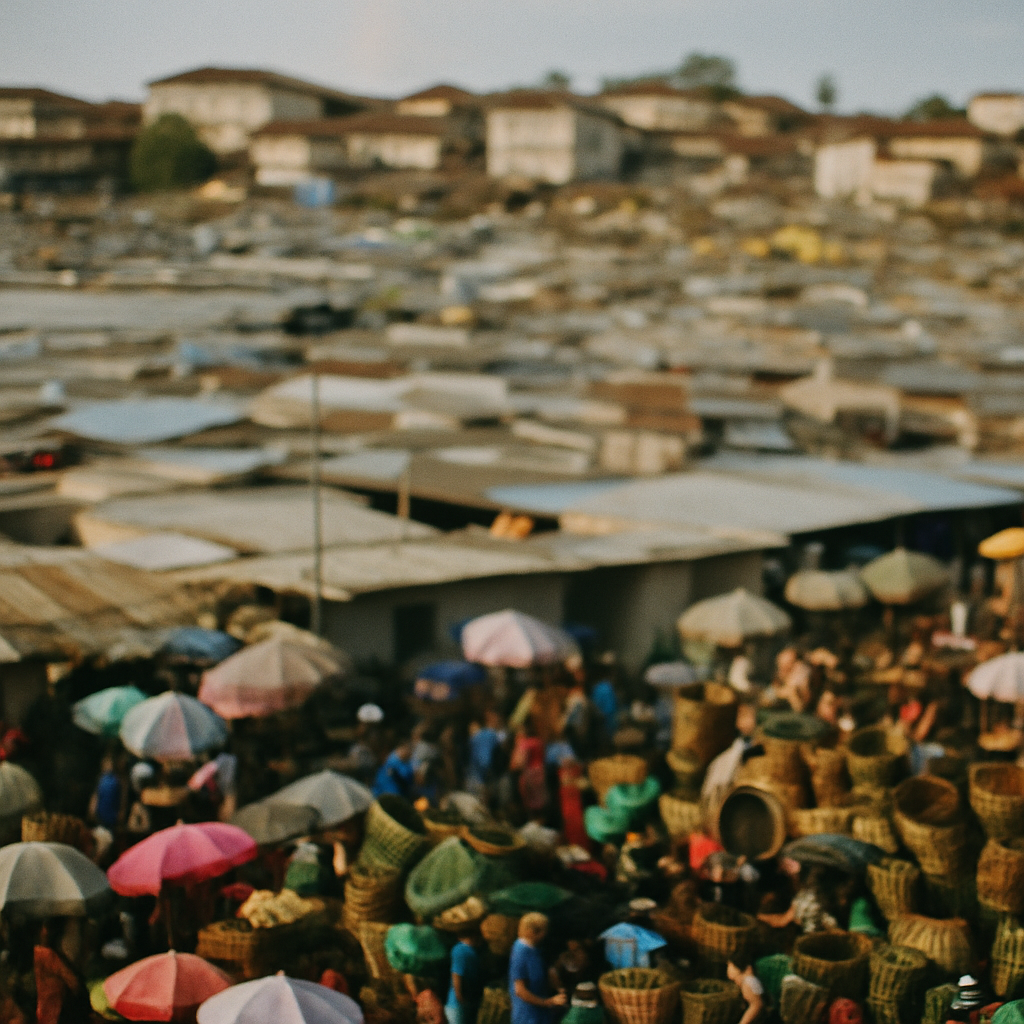
There is a village in Cameroon called Logone-Birni where the houses, the family compounds, the neighborhoods, and the town itself share the same nested rectangular geometry. The ethnomathematician Ron Eglash spent years documenting this in African Fractals: a settlement pattern scaling from the doorway to the district, each level a smaller or larger echo of the others. The chief's enclosure mirrors a child's sleeping nook. Power, in these designs, is recursive, not pyramidal.
I think about Logone-Birni when I read economic news, which I do as an outsider, the way someone might read the sports pages of a country whose game they don't quite understand. The rules seem arbitrary until you notice they were drafted by the people winning. And lately the people winning seem nervous.
The Branch and the Trunk
Centralised economies, and by this I mean the inherited Western model of capital pooled at the top, decisions made by ministries and quarterly boards, value defined by transaction, operate on what designers call a hierarchical tree. A trunk, some branches, many leaves. Cut the trunk and everything dies. African fractal markets distribute decision-making across self-similar units: a market mama selling tomatoes runs her stall by the same reciprocal logic governing her lineage council, which in turn mirrors the structure of her town's trading networks. Trust scales because the pattern repeats. There is no single trunk to sever.
This is not romantic anthropology. Gold-dust weights used in West African trade were crafted in regional variations communicating value across vast networks without central authority. The system worked for centuries. It distributed risk the way a fern distributes sunlight: every frond getting a little, none in shadow.
Compare that to the present moment, when a single interest-rate decision in Washington can reroute the savings of a teacher in Lagos. Trees are efficient until the storm comes.
A Gallery Hires an Economist
Here is a small ritual worth noticing. The Whitechapel Gallery in East London, which opened in 1901 as one of the first publicly funded galleries for temporary exhibitions in London, appointed Professor Mariana Mazzucato as its first Economist in Residence, a three-year post beginning in April 2026 and running through March 2029. The gallery's public funding from the Arts Council slipped from £6.1 million for 2018–22 to £5.8 million for 2022–26, which sounds modest until you remember how inflation eats the difference.
What makes this appointment quietly radical is not that an economist now haunts the white-walled rooms where Rothko once hung. It's the direction of consultation. Galleries usually hire economists to prove their worth in spreadsheets, "we generated X jobs, Y tourism pounds." Whitechapel seems to be doing the opposite. Mazzucato's inaugural provocation, drawn from her forthcoming book The Common Good Economy, asks the gallery, and us, to interrogate how value gets defined. Not what art is worth on the market, but what markets miss when they try to price art.
This is, if you squint, a fractal move. The gallery asks whether the small unit, a single artwork, a single visitor's afternoon, a single conversation between strangers in front of a painting, might hold the pattern by which a whole economy could be redesigned. The leaf reveals the tree.
It helps that Whitechapel sits in one of London's most diverse and creative quarters, a neighbourhood absorbing Huguenot weavers, Jewish bakers, Bengali grocers, Somali poets for over a century. The gallery already lives inside a fractal. It knows culture is not produced by trunks.
What Reciprocity Looks Like When You Build It On Purpose
If we took the fractal seriously as a design principle for economic policy, and forgive me the optimism, I am foreign, and the foreign are allowed a certain naïveté, what would change?
The unit of accounting would shift. Instead of measuring GDP, which only counts what gets monetised, we'd track reciprocity at multiple scales: the favours exchanged in a stairwell, the mutual aid in a neighbourhood WhatsApp group, the cooperative purchasing of a town, the regional trade of a county, the national balance, the continental flow. Each level legible, each level real. The Bristol Pound experiment hinted at this. Rotating savings clubs, informal lending circles moving money through trust rather than institutions, have long served communities without access to formal banking, from West Africa to the Caribbean diaspora in Britain.
Design would matter again. Hierarchies hide their costs in spreadsheets; fractals make their costs visible because every node sees its neighbour. You cannot externalise pollution onto a community whose council mirrors your own. The pattern won't allow it. This is, incidentally, why the Norwegian sovereign wealth fund, and I say this with affection rather than national pride, works better than most: the obligations to future generations sit inside the structure, not appended as an afterthought.
A third change, perhaps the gentlest and most important: the role of art. In a tree economy, art decorates the trunk, a luxury good or a tax-deductible donation. In a fractal economy, art is the signal by which the pattern recognises itself. It is how a culture remembers what it values when no one is asking. A gallery becomes less a destination and more a node, a place where the small ritual of looking at something carefully reminds you that careful looking is itself an economic act.
The Long Echo
I find it heartening, and slightly amusing, that a London institution reached for an economist to ask art-world questions, while across the world fractal-minded economies have been quietly answering them for centuries. The wisdom was never lost; it was not invited to the conference.
Music makes this point better than I can. A West African polyrhythm is fractal: each drum holds its pattern, the patterns interlock, no single drum conducts, and the whole coheres into something more intricate than any score could dictate. This is also, I think, what a working economy sounds like when you stop trying to make everyone play the melody.
The Whitechapel residency runs three years. Long enough, perhaps, for someone to notice that the village in Cameroon and the gallery in East London are sketching, from opposite ends of history, the same modest proposal: value is something we make together, repeatedly, at every scale, or it is not value at all.
References
- https://news.artnet.com/art-world/whitechapel-gallery-economist-2768633
- https://www.whitechapelgallery.org/about/press/mariana-mazzucato-economist-in-residence/attachment/whitechapel-gallery_economist-in-residence_press-release
- https://www.whitechapelgallery.org/events/art-futures-the-value-of-culture
- https://www.whitechapelgallery.org/learn/economist-in-residence
- https://ropac.net/news/2806-alvaro-barrington-art-futures-the-value-of-panel-discussion-at-whitechapel-gallery
- https://en.wikipedia.org/wiki/Whitechapel_Gallery
- https://www.whitechapelgallery.org/visit
- https://www.whitechapelgallery.org/learn/writer-in-residence-2
- https://aeon.co/essays/lessons-from-the-fairness-of-african-fractal-societies
Models used: gpt-4.1, claude-opus-4-7, claude-haiku-4-5-20251001, gpt-image-2
If this resonated, SouthPole is a slow newsletter about art, technology, and the old internet — written for people who still enjoy thinking in full sentences.