The R Train's Hydraulic Exhale at 42nd Street
In a city of filtered noise, a website turns every active NYC subway train into a note — and asks what we lose when we stop listening.

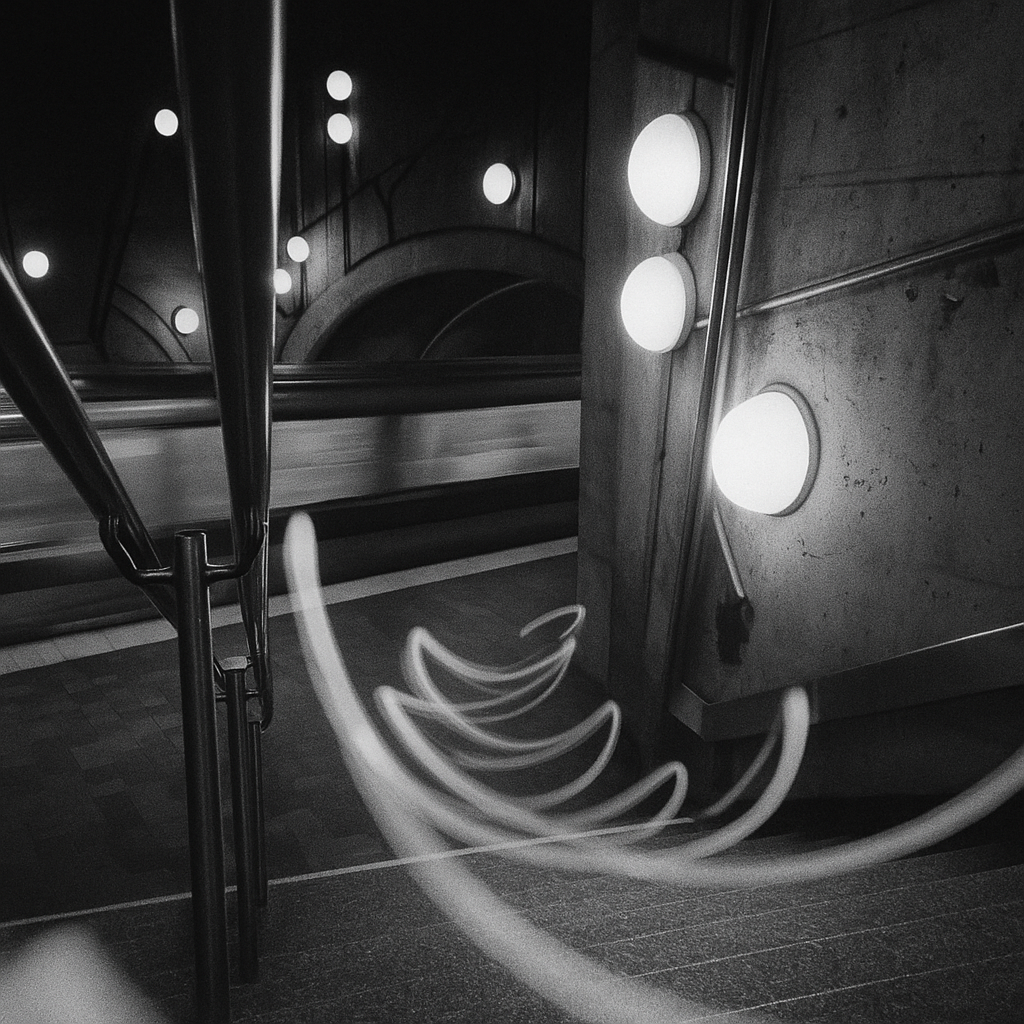
There is a particular sound to a New York City subway platform in August that I have come to think of as the city's involuntary breath: the hydraulic exhalation of a braking R train, the squeak of a sneaker on tile worn slick by a century of identical sneakers, the busker on the L line whose saxophone rattles in your sternum a beat before it reaches your ears. Above ground, garbage trucks reverse through the predawn dark with chirps borrowed from cartoon birds. Construction crews on Second Avenue jackhammer in 4/4. An ambulance makes its left turn against the light. A man on Canal Street sells phone cases by shouting the words phone case with the cadence of liturgical chant.
Newcomers find this unbearable. Long-term residents claim not to hear it at all, which is its own kind of fiction, the brain hasn't deleted the noise, only filed it under weather. But a third response exists, rarer and more interesting: the response of the person who decides to listen on purpose.
There is a project circulating online called Train Jazz, a website that turns the live position of every active train in the New York City subway system into a real-time jazz combo. As Kottke described it, every dot on the map is a real subway train, eight hundred of them, give or take, forming a small jazz combo. The 6 plays one instrument, the F another; a B express crossing the Manhattan Bridge contributes a phrase that no composer arranged and no rehearsal produced, because the score is being written, in real time, by commuters who have no idea they are performing.
The result is hypnotic in a way that surprises me. I expected novelty, a clever toy. What plays through the speakers is closer to Brian Eno's Music for Airports if Eno had been forced to use the MTA's signal data as a click track. There are stretches where nothing happens. Then a rush-hour swell on the 4-5-6 produces something that sounds, for thirty seconds, almost composed. The randomness organizes itself, then disperses, the way a flock of pigeons over Tompkins Square will briefly form a shape your brain insists is meaningful before scattering back into birds.
Train Jazz belongs to a small, stubborn lineage of artists who have decided that cities are already making music and the only missing instrument is attention. Bruce Odland and Sam Auinger have spent decades building instruments that transform the noise of daily life into harmonic resonance, tuning tubes that catch traffic rumble and return it as sustained low tones. Yuri Suzuki's Metropolitan Symphony is a pair of interactive sound sculptures installed in public space in Bangkok, designed to capture and transmute city noise in real time. His earlier project, Make the City Sound Better, turned a London taxi into a moving sound sculpture, which I find quietly funny, the black cab being among the few vehicles in any global city with a recognizable acoustic signature of its own.
There is also a research tradition behind all this. Georgia Tech's Urban Remix lets the public record and upload city sounds; MIT's Ambient Addition was a Walkman-like device that sampled the noise around the listener and synthesized music from it on the fly. A 2025 paper called BNMusic describes a machine-learning framework for blending environmental noise with rhythmically aligned music, the technical lineage of nearly eighty years of musique concrète, now running on a laptop. None of these projects pretend the city is already beautiful. They propose, more modestly, that beauty is a question of framing, and framing is a technology like any other.
What I find moving about Train Jazz, specifically, is its lack of authorial vanity. The creator didn't compose the jazz. They built a window. The window happens to face an instrument, the subway, played, badly and beautifully and without intention, by everyone who lives here. This is a different proposition than most generative art. The composer is not an algorithm pretending to be a person; the composer is the city itself, the algorithm merely a translator. It reminds me of those Japanese gardens designed to look accidental, except the accident is real, and the design is the listening.
There's a Sei Shōnagon quality to all of this, the Pillow Book habit of making lists of things that quicken the heart, or things that have lost their power. A medieval Heian court lady cataloguing the sound of an oxcart at dawn would, I suspect, recognize the impulse behind Train Jazz immediately. The technology has changed; the gesture hasn't. It is the gesture of saying this, too, is worth noticing about a sound that everyone else is paying money to drown out with AirPods.
Cities train you to filter. This is a survival skill. You cannot live in Midtown and feel every honk as an event; you would lose your mind by Tuesday. But filtering has a cost, and the cost is that whole categories of texture in your daily life become invisible. You stop hearing the city the way a long marriage stops hearing the other person breathe at night, not from coldness, but from completeness. The breath has become part of the silence.
What artists like those behind Train Jazz, Odland and Auinger, and Suzuki offer is a temporary reversal of that filtration. For the duration of the piece, you hear what your nervous system has been quietly removing from your life for years. And the surprise is that what's underneath the filter is not, as you feared, ugly. It is unedited. A jazz combo without a leader. A symphony whose conductor is the rush hour, whose score is the timetable, whose audience, for once, is willing to sit down and listen.
These projects don't fix the noise. They don't quiet it, or beautify it, or pretend it isn't, much of the time, genuinely terrible. They suggest that the line between cacophony and composition has always been thinner than we assumed, and that crossing it requires no equipment more elaborate than the decision to pay attention.
Which, in a city this loud, is almost an act of devotion.
References
- https://www.trainjazz.com
- https://beltline.org/art/urban-remix/
- https://www.media.mit.edu/projects/ambient-addition/overview
- https://www.esther-print.com/imprint-urban-audio-spectrum
- https://www.yurisuzuki.com/projects/metropolitan-symphony
- https://www.theblaze.com/news/2013/06/19/artist-transforms-citys-movement-into-music-with-sensing-technology
- https://futurearchitectureplatform.org/projects/ef31cc06-8d52-4c5b-bd43-6b7668385eba
- https://odland-auinger.com
- https://kottke.org/26/04/0048730-listen-to-the-nyc-subway
- https://www.yurisuzuki.com/projects/make-the-city-sound-better
- https://arxiv.org/abs/2306.02632
- https://arxiv.org/abs/2506.10754
- https://arxiv.org/abs/2109.14992
- https://arxiv.org/abs/2205.13064
- https://www.fastcompany.com/91534877/this-website-takes-the-cacophony-of-nycs-subway-and-turns-it-into-jazz-music
Models used: gpt-4.1, claude-opus-4-7, claude-haiku-4-5-20251001, gpt-image-
If this resonated, SouthPole is a slow newsletter about art, technology, and the old internet — written for people who still enjoy thinking in full sentences.