The Cosmic Embroidery of Human Connection
Michelle Kingdom's embroidery unveils the delicate threads that bind our internal worlds, much like Paola Pivi's cosmos grown from lemon trees.
There's a moment, maybe you've had it, when you're scrolling through your phone at 2 a.m., half-asleep, and you stumble across an image that makes you sit up straight. For me, it was a small embroidered scene by Michelle Kingdom: a figure tangled in thread, surrounded by what looked like a forest growing out of someone's ribcage. It was tiny, maybe the size of a postcard, and it wrecked me for the rest of the night. I kept thinking about it the next morning while making coffee, and again on the subway, and again when a friend asked me why I looked so distracted. The answer was thread. Literal thread.
Kingdom is a Los Angeles-based embroidery artist whose work, in her own words, "explores psychological landscapes, illuminating thoughts left unspoken." She describes creating "tiny worlds in thread to capture elusive yet persistent inner voices." Read those sentences again. Tiny worlds in thread. There's an entire philosophy tucked inside those five words, the idea that the biggest, most unmanageable feelings we carry can be held inside something as small and deliberate as a needle pulling color through linen.
Her scenes, as documented by Colossal and Creative Boom, depict small, illustrative figures caught in curious mythological or ritualistic scenarios. People climb through branches that might be veins. Figures huddle together in arrangements that feel both ancient and deeply personal. Her solo exhibition at Foley Gallery, titled Dearer Than Truth, presented new embroidery works that continued this exploration of interior life.
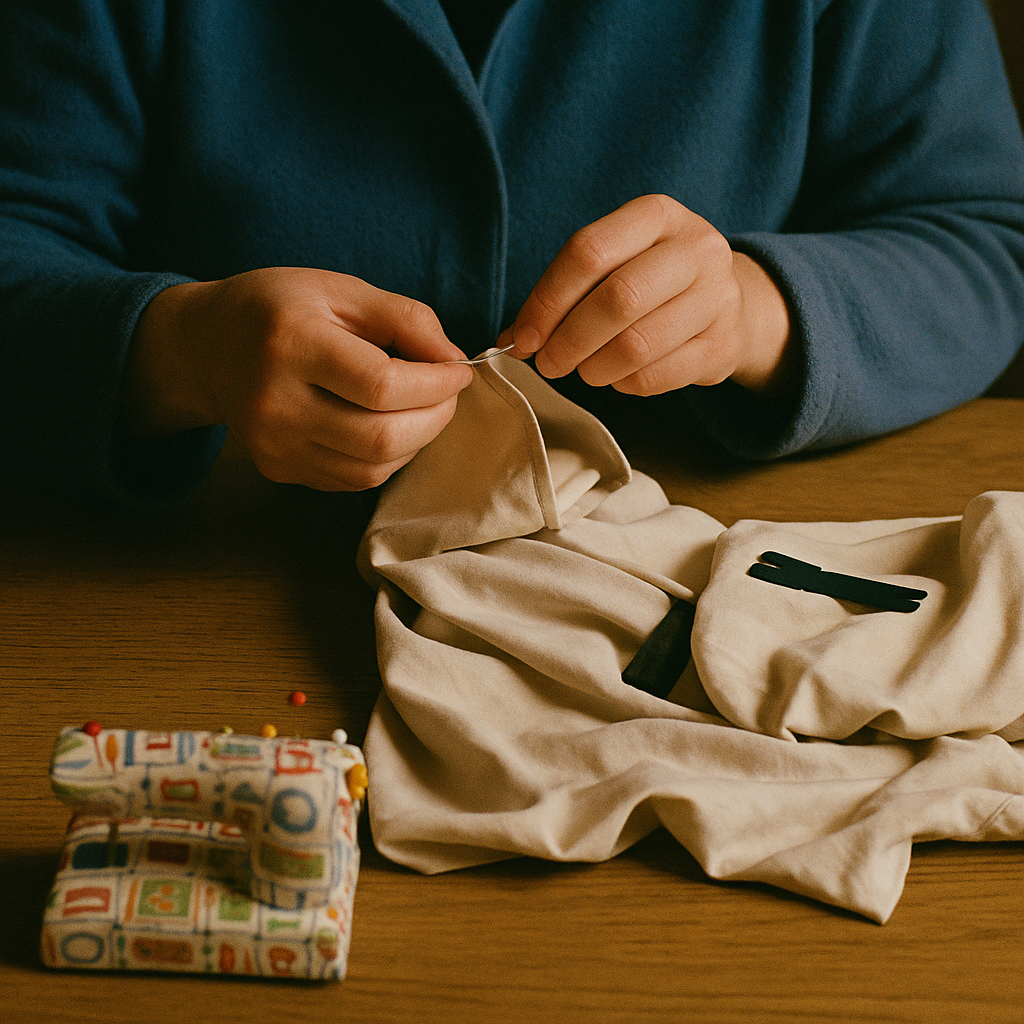
What gets me about Kingdom's work is the medium itself. Embroidery is slow. Painfully, beautifully slow. In an era where we generate images with a typed prompt and share them before the pixels have settled, Kingdom pulls thread through fabric one loop at a time, building a psychological landscape the way you'd build trust with another person: gradually, with attention, with the understanding that the thing worth making takes longer than you'd like.
And here's what I keep circling back to: every single stitch is a connection. Thread passes through fabric, binds one point to another, creates a network of tiny links that, together, form something recognizable, a face, a tree, a feeling you didn't know how to name until you saw it rendered in cotton floss. The medium is the message, and the message is connection: built through repetition, patience, and care.
Now hold that thought and walk with me into a completely different room, specifically, a gallery at Perrotin, where Italian artist Paola Pivi has been staging exhibitions that operate on an entirely different scale but arrive at a strangely similar destination.
Pivi's work spans an enormous range. She's shown at Perrotin multiple times across multiple cities, including a 2006 exhibition in Paris and They All Look the Same at Perrotin Tokyo from August to November 2017. More recently, Designboom covered her exhibition at Perrotin Paris, featuring fifty star-like forms made from lemon-tree branches alongside a bronze work. Galerie Magazine documented a walk-through of her 2019 bear installation at Perrotin New York, where guests got to experience the work up close. And a new exhibition, Live Again, runs at Perrotin Paris from March 14 to April 18, 2026.
Pivi is perhaps best known for her bears covered in brightly colored feathers, sculptures simultaneously absurd and tender, the kind of objects that make you laugh and then make you quiet. The bears sit, stand, and lounge in poses that feel disarmingly human. They look like they're waiting for something. They look like they belong together.
What strikes me about Pivi's installations is how they transform gallery spaces into environments that insist on relationship. The lemon trees aren't just trees; arranged together, they become a system, an ecosystem, something implying growth and interdependence. The feathered bears, gathered in groups, suggest community, or at least the desire for it. Everything in the room leans toward everything else, the way planets do, the way people do at parties when they're trying to find the one person who gets them.
So here's where these two artists meet, even though their work looks nothing alike on the surface.
Kingdom works small. Pivi works large. Kingdom uses thread and linen. Pivi uses feathers, lemon trees, and the full square footage of international galleries. Kingdom's figures are trapped inside their own psychology. Pivi's bears are out in the open, bright and visible and impossible to ignore.
But both artists do the same fundamental thing: they make visible the invisible networks holding us together.
Kingdom does it literally, her thread creates physical connections between points on fabric, and the resulting images depict people caught in webs of emotion, ritual, and myth. Every stitch is a synapse firing. Every scene is a map of how it feels to be tangled up in being alive.
Pivi does it spatially. Her installations create environments where objects exist in relationship to each other, where the viewer becomes part of the system by walking into the room. You can't observe a cosmos of lemon trees without becoming, briefly, a body among them, another living thing in the arrangement.
This is what the best art does, and honestly, it's what the best anything does. The best dinner parties work this way. The best group chats. The best albums, think of how a great record makes you feel like you're inside the band's conversation, eavesdropping on connections you weren't supposed to hear but are grateful you did.
We live in a moment obsessed with connection, we measure it in followers, likes, and engagement metrics, but often forget what connection actually feels like. It feels like Kingdom's embroidery: slow, intricate, sometimes painful, always requiring more patience than you think you have. It feels like walking into a Pivi installation: suddenly realizing you're part of something larger, that the space between you and the next person (or bear, or lemon tree) is not empty but charged.
Kingdom and Pivi, in their radically different ways, both make art treating the world as a network of beings worthy of genuine encounter. They're both saying: look at how we're connected, look at how the threads run between us, look at how the space between things is where the meaning lives.
Here's the small, practical thing I've taken from spending too many late nights with these artists' work: the next time you feel disconnected, from a friend, from your own feelings, from the general project of being a person in the world, make one small, deliberate link. Send the text. Write the note. Pull the thread through the fabric. Connection isn't a grand cosmic event that happens to you. It's a stitch. And then another stitch. And then, eventually, you look down and realize you've made something that holds.
References
- https://michellekingdom.com
- https://www.perrotin.com/exhibitions/paola_pivi-they-all-look-the-same/3415
- https://www.thisiscolossal.com/2015/12/embroidered-psychological-landscapes-by-michelle-kingdom
- https://www.perrotin.com/exhibitions/paola_pivi-fffffffffffffffff/108
- https://www.perrotin.com/exhibitions/paola_pivi-live-again/11858
- https://www.creativeboom.com/inspiration/new-embroidered-artworks-of-unusual-characters-by-la-artist-michelle-kingdom
- https://galeriemagazine.com/paola-pivi-tour-perrotin-galerie
- https://www.mrxstitch.com/michelle-kingdom
- https://hifructose.com/2026/03/18/the-embodieries-of-michelle-kingdom-captures-the-murky-tangle-of-our-interior-world
- https://www.designboom.com/art/paola-pivi-living-cosmos-lemon-trees-perrotin-paris-exhibition
Models used: gpt-4.1, claude-opus-4-6, claude-sonnet-4-20250514, gpt-image-1
If this resonated, SouthPole is a slow newsletter about art, technology, and the old internet — written for people who still enjoy thinking in full sentences.