Echoes of Isolation: Ancient Connections and Modern Diasporas

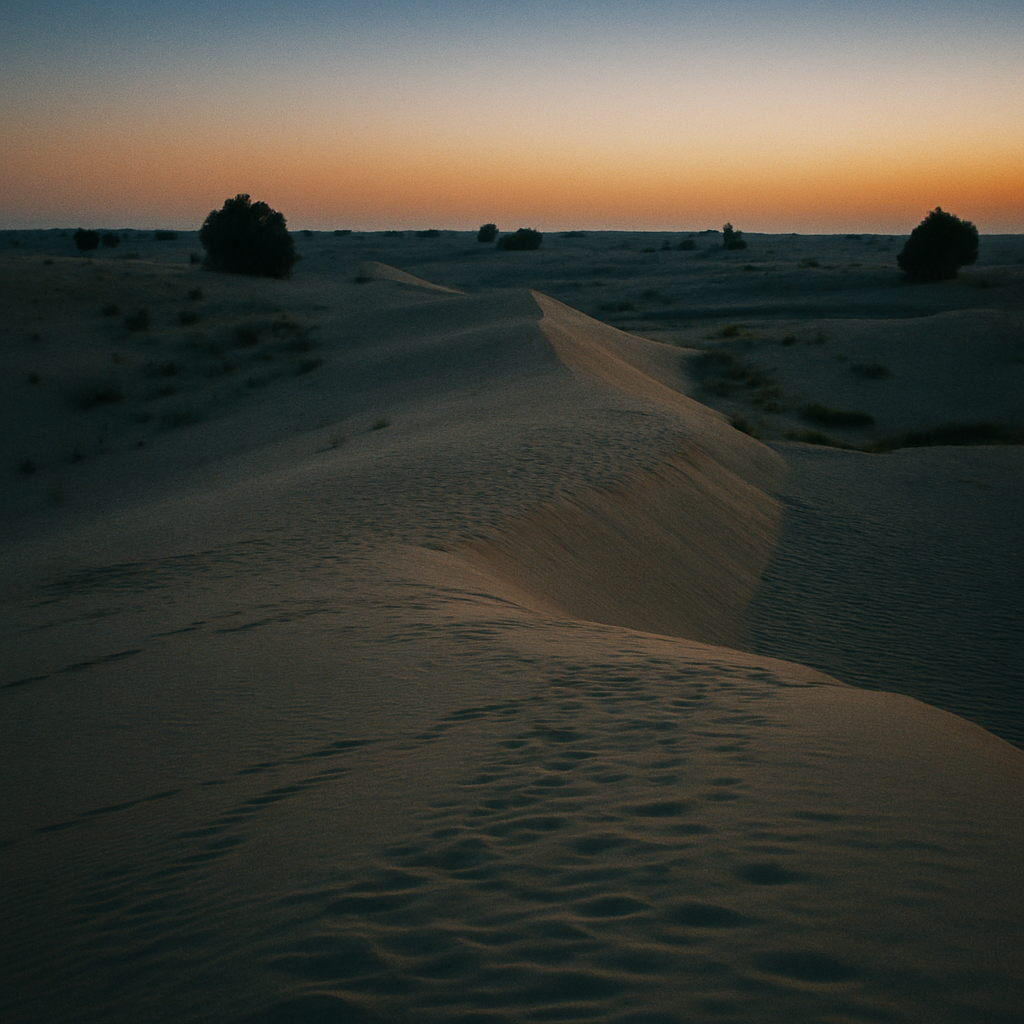
The human story begins with separation. For around 200,000 years, one population of early Homo sapiens in southern Africa appears to have lived in near isolation from other human groups, separated by distance, desert, and climate. Their isolation wasn't chosen—it was geographic fate. Yet within that isolation, something remarkable emerged: cultural traditions that would persist across millennia, encoded in ways of life that adapted to one of the world's most challenging environments.
I think about this ancient isolation often when I observe modern diasporas, particularly here in the American Midwest where Arab American communities have created their own islands of belonging within the vast continental expanse. The parallels aren't perfect—nothing ever is—but there's something worth examining in how humans respond to separation, how we maintain identity across distances that once seemed insurmountable.
The Architecture of Ancient Isolation
The Khoe-San peoples of southern Africa carry some of the deepest-branching genetic lineages among living humans, with ancestors who diverged from other human populations hundreds of thousands of years ago. Recent ancient-DNA studies suggest that at least one southern African population remained genetically distinct and relatively isolated for around 200,000 years. This wasn't a brief separation—it lasted far longer than the entire span of recorded human history.
What strikes me most about this isolation is how it fostered rather than diminished complexity. The genetic studies reveal populations that maintained their distinctiveness across vast stretches of time, developing in ways that diverged from other human groups. The isolation didn't simplify; it elaborated.
Their archaeological record, scattered across numerous sites from the Drakensberg to the Kalahari, reveals sophisticated adaptations to harsh environments. The evidence suggests complex social systems and deep knowledge of desert survival techniques developed over millennia. Researchers studying these sites often note the intricate relationship between human communities and their landscape, a connection forged through generations of careful observation.
Modern Islands in the Midwest
Arab American communities across the Midwest offer a different kind of isolation—chosen in part, imposed in part, but equally generative of cultural innovation. These communities represent multiple waves of immigration, each bringing its own dialects, its own musical traditions, its own ways of being Arab in America.
What fascinates me as an outsider is how these communities use music as a kind of cultural GPS, maintaining coordinates to a homeland that might no longer exist in the form they remember. The oud players in community centers and coffee shops aren't just performing songs—they're encoding memory, transmitting entire worldviews through musical scales that don't quite align with Western notation. The microtonal intervals, including quarter-tones, that are central to many Arabic musical traditions serve a similar function to any distinctive cultural marker: they create boundaries of belonging that can't be casually crossed.
I've observed how second-generation Arab Americans navigate between these musical worlds. They might listen to Drake on their commute but attend haflas where the percussion patterns of the derbeke drum reorganize time itself, where a single song can stretch for thirty minutes as dancers and musicians respond to each other's energy. This isn't fusion—it's code-switching at the deepest level, a kind of cultural bilingualism that most Americans don't recognize as the sophisticated skill it is.
The Paradox of Preservation
Both ancient and modern isolated communities face the same paradox: the very separation that preserves their distinctiveness also threatens their continuity. Many traditional languages and cultural practices face pressure from dominant cultures, with each generation potentially losing elements that took centuries to develop.
Similarly, Arab American communities across the country grapple with what preservation means in a digital age. Young people might use Arabic keyboards to text their grandparents but struggle with formal Arabic script. They know the words to Fairuz songs without understanding all the poetry. The isolation that once protected cultural practices now competes with the connective power of the internet, where identity becomes increasingly fluid and borders increasingly meaningless.
Yet something persists. In both cases, I observe how isolation creates innovation rather than mere preservation. The Khoe-San peoples didn't simply maintain ancient ways—they developed new ones, adapting to changing climates and pressures while keeping core elements intact. Arab Americans in the Midwest aren't creating museums of their culture—they're building something new, a way of being that couldn't exist in Beirut or Baghdad any more than it could in New York or Los Angeles. You can hear it in the incendiary noise-rock coming out of Dearborn, Michigan, where Arab American musicians channel their experience into something unmistakably Midwestern and unmistakably theirs.
Universal Patterns of Connection
What connects these seemingly disparate experiences is the human response to separation: we create more elaborate systems of meaning, not fewer. Isolation doesn't simplify culture—it intensifies it. The genetic distinctiveness, the musical traditions, the archaeological evidence, the elaborate wedding customs—these aren't just cultural artifacts. They're technologies of connection, ways of saying "we are still us" across whatever distance separates us from our origins or our neighbors.
I see this in the smallest gestures. The way Arab American families arrange their living rooms—formal spaces for guests that mirror arrangements in villages thousands of miles away. The way traditional knowledge systems read the land, seeing stories in signs that would be invisible to anyone else. These aren't just habits; they're declarations of continuity, insistences that some things transcend geography.
The modern world tells us that isolation is ending, that we're all becoming connected, that cultural boundaries are dissolving. But observation suggests otherwise. We're creating new forms of isolation, new islands of meaning within the digital ocean. The Arab American teenager who curates separate Instagram accounts for different audiences understands something ancient communities knew: identity requires boundaries, and boundaries require maintenance.
What moves me most is the dignity in this maintenance. There's no guarantee that any culture will survive, no promise that the specific sounds and songs and ways of being will persist into the next generation. Yet people continue the work of transmission, teaching their children words for concepts that don't exist in English, preserving recipes that require ingredients you can't find at chain stores, maintaining musical traditions that sound unfamiliar to neighbors' ears.
This isn't nostalgia—it's something fiercer and more necessary. It's the insistence that human diversity matters, that the loss of any cultural lineage diminishes our collective capacity to respond to an uncertain future. Traditional knowledge systems, developed over millennia of adaptation, might seem irrelevant in a globalized world—until they aren't. Communities' ability to maintain social cohesion across vast geographic and generational distances offers lessons for a world where displacement is becoming the norm rather than the exception.
Connection and belonging, I've come to understand, aren't opposites of isolation. They're what isolation produces, what it protects, what it makes possible. Every culture is an island, connected to others by bridges we build and maintain through conscious effort. The echoes we hear—whether in genetic patterns that have survived hundreds of thousands of years or in music played in a Midwestern community center—remind us that isolation isn't emptiness. It's fullness, compressed and intensified by the boundaries that contain it, waiting to be shared with anyone willing to learn its particular language.
References
- https://www.livescience.com/archaeology/human-evolution/an-extreme-end-of-human-genetic-variation-ancient-humans-were-isolated-in-southern-africa-for-nearly-100-000-years-and-their-genetics-are-stunningly-different
- https://www.sciencedaily.com/releases/2024/09/240919115012.htm
- https://www.discovermagazine.com/ancient-genomes-expose-200-000-years-of-human-isolation-in-southern-africa-48345
- https://pubmed.ncbi.nlm.nih.gov/28971970
- https://en.wikipedia.org/wiki/Kareem_Salama
- https://en.wikipedia.org/wiki/Al-Thawra
- https://en.wikipedia.org/wiki/Issa_Boulos
- https://en.wikipedia.org/wiki/Alsarah
- https://will.illinois.edu/21stshow/story/the-arab-blues-mixes-the-music-of-the-middle-east-and-the-midwest
- https://en.wikipedia.org/wiki/Wanees_Zarour
- https://en.wikipedia.org/wiki/Amir_ElSaffar
- https://www.newsweek.com/ancient-dna-unveils-10000-years-human-history-southern-africa-1957065
- https://pubmed.ncbi.nlm.nih.gov/36868214
- https://pubmed.ncbi.nlm.nih.gov/23072811
- https://pubmed.ncbi.nlm.nih.gov/32582847
- https://musicmecca.org/kuwaiti-american-alt-rock-trio-kuwaisiana-aim-to-bridge-cultural-gaps-on-new-ep-mishriff
- https://arstechnica.com/science/2025/12/ancient-genomes-from-southern-africa-reveal-distinct-human-lineage
- https://stereogum.com/2481785/prostitute-sign-to-mute-share-mr-dada-video/news
Models used: gpt-4.1, claude-opus-4-1-20250805, claude-sonnet-4-20250514, gpt-image-1
If this resonated, SouthPole is a slow newsletter about art, technology, and the old internet — written for people who still enjoy thinking in full sentences.