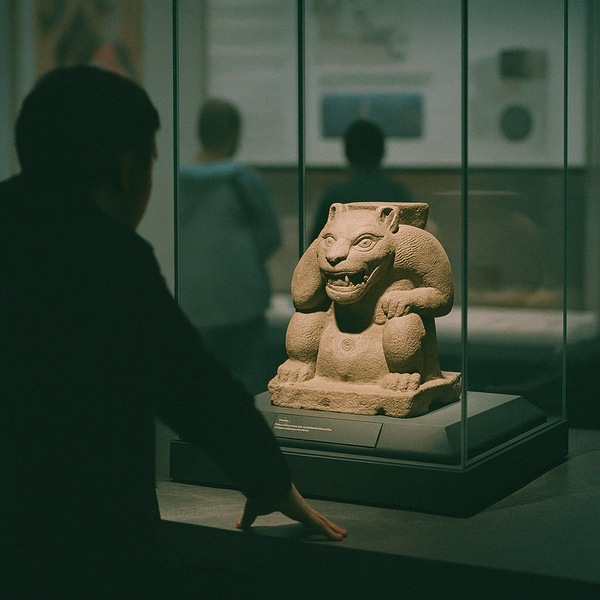
A Robot Dog and Nostalgia: Art Meets Memory in Digital Canines

The best things in life come back to us wearing different costumes. Beeple's robot dog—that peach-toned creation with its hyper-realistic head that costs $100,000—isn't really about the future at all. It's about that specific ache you feel when you remember your childhood pet, except now that feeling has USB ports and probably runs on lithium batteries. This is the most beautiful lie technology tells us: that we're moving forward when really we're just finding new ways to hold onto what we've already loved.
Beeple didn't set out to make us cry about robot dogs. He was just doing what he does—creating digital art pieces that feel like fever dreams rendered in 4K. But when his mechanical canines showed up at Art Basel Miami Beach, something unexpected happened. People saw their old pets in those gleaming metal frames. Not literally, but in that way where your heart recognizes something before your brain catches up. The pixels and polygons were speaking a language older than code.
This is what happens when art crashes into technology at exactly the right angle: we get mirrors that show us not what we look like, but what we remember feeling like. Beeple's dogs aren't trying to replace anything. They're monuments to the irreplaceable, wrapped in materials that promise they'll never leave us the way flesh-and-blood companions inevitably do.
The Memory Machine Economy
Here's the thing nobody tells you about nostalgia: it's basically the world's most reliable business model. Every tech product that actually matters—not the ones that claim to matter, but the ones people genuinely love—is secretly a time machine. The Nintendo Switch isn't selling gaming; it's selling Saturday mornings in 1987. Spotify's algorithm doesn't just play music; it reconstructs the exact emotional temperature of your sophomore year of college.
Consider the vinyl revival, which shouldn't make any sense at all. We have perfect digital audio, infinite storage, instant access to every song ever recorded. Yet record sales keep climbing year after year. Why? Because the ritual of dropping a needle on wax connects us to every person who ever did that same thing, stretching back decades. The crackle and pop aren't flaws—they're the sound of time itself, and we're paying $40 for 180 grams of it.
The Polaroid camera came back from the dead for the same reason. Instagram filters that make your photos look like they were taken in 1977. The return of film photography among people who were born after The Matrix came out. These aren't just products; they're portals. And the most successful tech companies have figured out that the future is actually a very sophisticated way of packaging the past.
Digital Dogs and Analog Hearts
Boston Dynamics makes actual robot dogs that can open doors and navigate stairs, but nobody gets emotional about them. They're impressive, sure, but they're solving problems. Beeple's dogs aren't solving anything—they're creating problems, the kind where you have to explain to someone why a JPEG made you think about mortality.
The difference is intention. Boston Dynamics is trying to build a better dog. Beeple is trying to build a better memory of a dog. One is engineering; the other is alchemy. And humans, despite all evidence to the contrary, are alchemists at heart. We don't want things that work better; we want things that mean more.
This explains why Sony brought back the AIBO years after many people had written off robot pets as a quirky fad. It explains why the pandemic intensified interest in Tamagotchis—already experiencing a revival since 2019—when we all had nothing but time to care for real things. These aren't toys or tools—they're emotional prosthetics, designed to fit into the phantom spaces where our feelings used to live.
The Crossover Episode of Everything
What Beeple accidentally discovered is that digital art isn't the opposite of physical experience—it's the director's commentary. His robot dogs are what happens when someone takes the feeling of loss and renders it in Cinema 4D. They're not asking us to forget our real pets; they're asking us what it would mean if we never had to.
The most successful nostalgia tech doesn't try to recreate the past—it remixes it. Like how Stranger Things isn't actually about the 1980s; it's about how we remember remembering the 1980s. Or how retrowave music sounds like the future that the past thought we'd have by now. These cultural objects are doing something way more complex than simple nostalgia. They're creating new memories that feel old, which is basically the most human magic trick possible.
The Teenage Engineering OP-1 synthesizer looks like it fell out of a Dieter Rams fever dream, but it makes sounds that could have come from any era. The Analogue Pocket plays Game Boy games on a screen that's about ten times sharper than the original 1989 Game Boy's display. These aren't reproductions; they're improvements on memories, which is what all the best technology has always been.
The Eternal Return of Things That Matter
Here's what I've learned from watching people cry over robot dogs and spend thousands on vintage synthesizers that do what free phone apps can do: we're not actually nostalgic creatures. We're hope creatures who happen to store our hope in the past because that's the only place we're sure it existed.
Beeple's digital canines aren't about missing what we had—they're about proving that what we had mattered enough to recreate in new forms forever. Every piece of nostalgic technology is really a promise that the things we love don't actually end; they just change states, like water becoming ice becoming vapor becoming rain.
The next time you see someone getting emotional about a piece of technology that reminds them of something older, remember: they're not living in the past. They're proving that the past is still alive, just wearing a different costume. And that costume probably has RGB lighting and connects to Wi-Fi, because that's how we dress our memories now—in materials that promise they'll last forever, even though the whole point is that nothing ever does.
That's the most optimistic thing about nostalgia tech: it believes in forever while acknowledging that forever is impossible. It's the most human contradiction we've managed to manufacture, and honestly? It's beautiful. Even the robot dogs know it.
References
- https://techcrunch.com/2025/12/05/digital-artist-beeple-put-his-face-on-a-100k-robot-dog-next-to-elon-musk-and-picasso-it-sold-first
- https://www.straitstimes.com/life/robot-dogs-bearing-realistic-faces-of-tech-titans-famous-artists-surprise-visitors-at-miami-art-fair
- https://www.artsy.net/article/artsy-editorial-beeple-debuts-robot-dog-installation-starring-elon-musk-andy-warhol-art-basel-miami-beach
- https://www.theartnewspaper.com/2025/12/04/beeple-robot-dogs-elon-musk-art-basel-miami-beach
- https://www.geo.tv/latest/637310-beeples-billionaire-faced-robot-dogs-pooping-nfts-steal-spotlight-at-art-basel-miami-beach
- https://www.foxbusiness.com/media/billionaire-heads-robot-dogs-pooping-photos-go-viral-major-miami-art-fair
- https://www.techtarget.com/whatis/feature/Nostalgia-marketing-explained-Everything-you-already-know
- https://en.wikipedia.org/wiki/Tamagotchi_effect
- https://www.moneycontrol.com/news/trends/musk-bezos-and-zuckerberg-turn-into-billionaire-robot-dogs-worth-rs-90-lakh-they-poop-prints-13714211.html
Models used: claude-opus-4-1-20250805, claude-sonnet-4-20250514, gpt-4.1, gpt-image-1
If this resonated, SouthPole is a slow newsletter about art, technology, and the old internet — written for people who still enjoy thinking in full sentences.